
SubMeet Blog Posts
Write your:
Biography, story, article or tidings.
Maximum 50.000  symbols (Depends on the browser) one post.
Maximum 10 posts per day, 100 posts per month, for one user.
We recommend using the Firefox browser to publish a post.


 Marshal
This article is crafted for history enthusiasts, linguists, archaeologists, and curious readers intrigued by the mysteries of ancient civilizations. Dive into a comparative analysis of Egyptian and Mayan hieroglyphs, exploring their similarities, differences, and the challenges of deciphering these intricate writing systems. Whether you're a student of ancient scripts or simply fascinated by humanity's timeless quest for expression, this piece offers insights into the shared legacy and unique identities of these remarkable civilizations.
Similarities Across Hieroglyphic Systems
1. Visual Symbolism
All hieroglyphic systems employ visual symbols to convey meaning. These symbols often depict objects, animals, or human figures as literal representations or abstract ideas. For example, Egyptian hieroglyphs use images of birds, tools, and body parts, while Mayan glyphs incorporate stylized depictions of gods, animals, and celestial phenomena.
2. Dual Functionality: Phonetic and Ideographic
Hieroglyphs commonly serve dual purposes:
Phonetic symbols represent sounds or syllables.
Ideograms symbolize concepts or objects.
For instance, in Egyptian hieroglyphs, a “bee” could signify the sound “b” or represent royalty. Similarly, Mayan glyphs often combine phonetic components with logograms to form complex messages.
3. Religious and Monumental Usage
Hieroglyphs often adorned temples, tombs, and monuments, reflecting their sacred and ceremonial importance. Inscriptions like the Pyramid Texts document religious rituals and beliefs about the afterlife in Egypt. Similarly, Mayan stelae record historical events, ruler's achievements, and cosmological narratives.
Differences Between Hieroglyphic Systems
1. Structural Complexity
Egyptian Hieroglyphs: This system, which comprises over 1,000 symbols, balances phonograms, ideograms, and determinatives (contextual markers).
Mayan Hieroglyphs: With approximately 800 glyphs, they form a logographic-syllabic script requiring intricate combinations to construct meanings.
2. Writing Mediums
Egyptians inscribed hieroglyphs on stone, papyrus, and temple walls.
Mayans etched glyphs into stelae, pottery, and codices.
3. Decipherment Challenges
The ease of deciphering hieroglyphs varies:
The Rosetta Stone facilitated the understanding of Egyptian hieroglyphs by providing a trilingual inscription in Greek, Demotic, and hieroglyphic scripts.
Mayan glyphs were deciphered only in the 20th century through the work of linguists and archaeologists.
Famous Hieroglyphs and Their Translations
1. The Rosetta Stone
Discovered in 1799, the Rosetta Stone features the same text in Greek, Demotic, and Egyptian hieroglyphs. Jean-François Champollion's decipherment in 1822 unlocked the mysteries of ancient Egypt, revealing administrative decrees and religious practices.
2. The Pyramid Texts
Inscribed in the pyramids of Saqqara, these hieroglyphs are among the oldest religious texts. They detail spells and rituals to guide pharaohs to the afterlife.
3. Mayan Stelae
Stela D from Copán records the reign of 18-Rabbit, a prominent Mayan ruler. Its glyphs narrate his lineage, achievements, and astronomical alignments.
A Chronology Showing the Difficulties in Decoding Hieroglyphs Down to the Present Time: Which Hieroglyphic Symbols Have Not Been Deciphered Yet?
Undeciphered Symbols:
Egyptian Hieroglyphs: Some symbols, particularly those used for abstract ideas like emotions or more complex concepts, have resisted complete interpretation.
Maya Glyphs: Many symbols, especially those related to calendrical data, require more study to understand their meanings.
List of Undeciphered Hieroglyphs by "Names"
Egyptian Hieroglyphs:
Symbols representing abstract concepts (e.g., emotions, complex ideas)
Rare or unique glyphs used in religious contexts
Symbols found on isolated monuments not yet studied in depth
Maya Glyphs:
Symbols related to calendrical data (e.g., those used for recording dates, and agricultural cycles)
Glyphs with unclear phonetic or logographic meanings
Unstudied pottery or codices that could provide new insights
This chronology and list provide a glimpse into the challenges by scholars in decoding these ancient scripts and highlight the ongoing quest for knowledge in understanding the written legacy of our ancestors.
Revealing Ancient Voices: 15 and 12 Deciphered Sentences from Egyptian and Mayan Hieroglyphs
Egyptian Hieroglyphs:
1. “Rise, O Teti, you shall not die!” - From the Pyramid Texts, this inscription was meant to guide the deceased pharaoh through the afterlife, ensuring immortality.
2. “The king is the mighty bull, the conqueror of chaos.” - An inscription often found in temples, signifying the pharaoh’s role as a powerful deity who maintains order and combats chaos.
3. “May the gods protect this house and its people.” - Found on tombs and homes, this phrase invokes the gods to watch over the living and the deceased.
4. “Words of power are written on this wall to protect the pharaoh.” - A magical text meant to provide divine protection and ensure the king’s safety in life and death.
5. “Let the sun god Horus watch over me.” - An invocation for divine protection and guidance, reflecting the importance of the sun god in daily life and death.
6. “The goddess Hathor brings joy to the heart of the pharaoh.” - Inscribed on walls of temples and tombs, this phrase honors Hathor, goddess of love, music, and joy, and her special relationship with the king.
7. “Words of power to silence enemies and bring peace.” - Used in spells and magical texts to protect against evil and enemies, ensuring the of the deceased in the afterlife.
8. “May Osiris, god of the afterlife, welcome me into his realm.” - Found on tombs and funerary objects, this inscription expresses a desire for a favorable afterlife and acceptance by the god Osiris.
9. “The bull of the West guides the dead through the underworld.” - A reference to a god or spirit who assists in the journey through the underworld, providing protection and guidance to the deceased.
10. “The pharaoh’s name is written here in gold, signifying his eternal rule.” - Found in royal inscriptions, this sentence emphasizes the king’s divine status and his everlasting legacy.
11. “The boat of millions sails across the sky, bringing the deceased to the afterlife.” - An image and text describing the celestial journey of the dead, often associated with the sun god Ra.
12. “With these words, the pharaoh’s soul is bound to the stars.” - A poetic inscription meant to immortalize the king’s soul and elevate it to the heavens.
13. “Year after year, we transport the white stone from Tura to the pyramid of Khufu.” - This inscription, recorded by a scribe named Merer, describes the transportation of limestone from Tura quarries to Giza for casing the Great Pyramid. It provides insight into the labor and engineering processes during Khufu’s reign.
14. “The Friends of Khufu Gang.” - This phrase, painted on stones in red ink, identifies one of the labor crews who built the pyramid, showing their pride and loyalty to the king. These inscriptions reveal logistical details, the scale of the workforce, and the reverence held for Khufu during his reign.
15. “Khnum-Khufu, the Protector of Egypt, Builder of the Horizon.” - This is Khufu's full throne name, which means "Khnum protects me." Khnum was an important deity associated with creation and fertility. "Protector of Egypt": Indicates Khufu's role as the ruler and guardian of the land. "Builder of the Horizon": Refers to the Great Pyramid as the "Horizon of Khufu," a structure symbolizing the pharaoh's eternal connection to the sun god Ra and his journey to the afterlife.
Mayan Hieroglyphs:
1. “18-Rabbit, King of Copán, has ascended the throne.” - An inscription on a stela documenting the accession of a Mayan ruler, emphasizing the continuity of royal power.
2. “May the gods bless this land and its people.” - A common prayer found on stelae and other monuments, calling for prosperity and protection from the gods.
3. “The moon goddess grants favor to the people of this city.” - An invocation honoring lunar deities and their influence over time and agriculture.
4. “Let the rains bring fertility to the fields.” - A plea for agricultural abundance, often recorded to ensure successful harvests.
5. “Words of wisdom from the ancestors guide our rulers.” - Reflecting the Mayan belief in ancestral guidance, these inscriptions linked rulers to the wisdom of the past.
6. “This stela commemorates the birth of a new dynasty.” - An inscription marking the beginning of a new era or dynasty, showing the cyclical nature of Maya history.
7. “May the gods protect this ruler and his family.” - A protective prayer for the leader and his descendants, often found in inscriptions associated with new rulers.
8. “The calendar begins anew on this day.” - Signifying a new cycle in the Mayan calendar, important for agricultural planning and ritual activities.
9. “The ruler’s name is written in glyphs, marking his reign.” - Highlighting the importance of documenting the reign of a king, with his name and titles encoded in glyphs.
10. “This text records the events of the 13th k’atun, marking the end of an era.” - A reference to a significant period in the Mayan long-count calendar, often tied to monumental events.
11. “Let this sacrifice honor the gods and bring us to favor.” - A ritual offering inscription, explaining the importance of blood sacrifices to maintain cosmic order.
12. “The stars align in the sky to mark a significant event.” - An inscription linking astronomical observations to important ritual or historical events.
These sentences illustrate how hieroglyphs served not only as a means of communication but also as a medium for expressing religious beliefs, royal proclamations, and cultural narratives in ancient Egypt and the Mayan civilization.
Conclusion
The study of hieroglyphs reveals humanity’s universal desire to preserve history, express spirituality, and connect with the cosmos. While the similarities highlight shared human creativity, the differences underline the unique cultural contexts of ancient civilizations. As research continues, undeciphered hieroglyphs promise to unlock more insights into our ancestors’ lives and beliefs.
Discover the similarities and differences between Egyptian and Mayan hieroglyphs. Learn how ancient scripts were deciphered, their cultural significance, and the undeciphered mysteries that still captivate scholars today.
Marshal
The mighty pyramids of Egypt have captivated the minds of historians, engineers, and dreamers for centuries. Their sheer size, geometric precision, and the staggering logistics of their construction leave us in awe of ancient Egyptian ingenuity. But how exactly did they achieve this monumental feat?
Scholars and researchers continue to debate the methods used to build these timeless structures. While no single definitive answer exists, a compelling range of approaches and options sheds light on the remarkable capabilities of the ancient builders.
Key Theories and Approaches
Ramp Theories: Many experts believe that vast ramps of earth and wood were constructed to haul the massive stone blocks. Potential ramp variations include:
Straight Ramp: A single, colossal ramp leading directly up the pyramid's face. This method, while simple in concept, would require an enormous amount of material and labor.
Zig-zag ramps: A series of ramps winding up the sides of the pyramid, potentially reducing the overall ramp size.
Internal Ramps Some theories posit ramps constructed within the pyramid itself, growing as the structure rose.
The Water Theory: This theory suggests the skilled use of water in the construction process. X Persons could have created temporary canals to transport stones on barges closer to the pyramid site. Water might also have been used to create a lubrication system for hauling blocks.
Lever Systems: The ancient X Persons were adept at using simple machines. They possibly employed lever systems for lifting and positioning the massive blocks that form the pyramids.
Detailed Construction Insights
Quarrying Techniques: Stones were primarily extracted from nearby quarries. Workers likely used copper chisels, wooden wedges, and water to create fractures in the rock and release the blocks.
Stone Transportation: Enormous numbers of workers would have hauled stones using sleds, rollers, and likely water to ease friction. Boat transport was crucial for moving blocks over longer distances.
Precision Placement: The exact method for achieving perfect pyramid alignment is still debated. Theories range from astronomical observations to ingenious surveying techniques.
Mortar: The X Persons used a gypsum-based mortar as a bonding agent between some stone layers.
It's entirely possible that the construction of the pyramids utilized a combination of natural and concrete-like stones.
Here's why this hypothesis has merit:
Supporting Evidence: Studies conducted by materials scientists, like Michel Barsoum, have found that certain stones, particularly in the inner and outer casings of the pyramids, exhibit characteristics inconsistent with purely natural limestone. The presence of microstructures and chemical compositions suggests a possible use of a reconstituted limestone mixture.
Plausible Explanation: The idea of both natural and concrete stones could explain the seemingly contradictory evidence found within the pyramids. The large, structural blocks might be natural stone, while the concrete-like material was likely used for:
Upper levels: Easier to mold and transport for the higher sections.
Finer Details: Used for intricate carvings or to fill gaps where natural stone was less suitable.
Developing a form of early concrete wouldn't be outside the realm of possibility. The idea of both natural and concrete stones in the pyramids could reconcile conflicting evidence and offer a fascinating glimpse into the ingenuity of the ancient X Persons. This possibility highlights the importance of ongoing scientific investigations to push our understanding of these amazing structures.
Ease of Use
Natural stones: Quarrying, shaping, and transporting massive natural stones presents considerable challenges. It required immense labor, skilled stonecutters, and logistical coordination.
Concrete: Creating a concrete-like mixture and casting stones in molds on-site could potentially be less labor-intensive. It would, however, likely require a sophisticated understanding of materials, mixture ratios, and the curing processes.
Logistical Factors
While concrete might seem easier at first glance, there are other factors to consider:
Resource Availability: The Giza plateau naturally provided limestone in abundance. Creating concrete would need sourcing lime and other binding agents, potentially adding complexity.
Durability: The pyramids needed to endure for millennia. The long-term durability of a hypothetical ancient concrete was unknown, whereas natural stone had a proven track record.
Showcase of Power, Skill, and Quality
Absolutely! The use of massive, perfectly fitted natural stones in the pyramids could be seen as a powerful statement on multiple levels:
Strength: The ability to command the labor and resources to handle enormous stones demonstrated the strength and organizational capacity of the X Person.
Skill: The precision with which these stones are cut, moved, and positioned highlighted the extraordinary skill of X architects, engineers, and stonemasons.
Quality and Permanence: Using natural stone, a symbol of endurance, emphasized the intended eternal nature of the pyramids and the lasting legacy of the X Person.
While a concrete-like material could have offered some advantages, the use of natural stone fits a broader narrative of awe-inspiring effort, skill, and a drive for eternal monumentality. Choosing the more challenging path with natural stone likely played a large role in the symbolic power the pyramids hold.
Could these colossal structures be more than tombs?
Aligning with the Cosmos: A Celestial Gateway?
The pyramids' precise astronomical alignments are undeniable. The three main pyramids at Giza mirror Orion's belt in the night sky, while the Great Pyramid's sides align with cardinal directions. This intricate celestial correlation begs the question: were the pyramids built to mimic the heavens, or perhaps act as a gateway to a higher plane?
The Nile as the Milky Way: An Earthly Reflection?
The Nile River, the lifeblood of Egypt, snakes through the landscape mirroring the Milky Way. This terrestrial echo of the cosmos adds another layer to the celestial connection. Could the pyramids, positioned along the Nile, represent significant markers within this cosmic map?
The direct intervention of God in the construction of the Pyramids is a sign and similar to a military exercise or Astronomical Expertise:
This theory challenges the traditional narrative. Were the pyramids built by God or a testament to the advanced astronomical knowledge of the Egyptians?
Unearthing the Truth: Re-examining the Evidence
This perspective compels a re-examination of existing evidence. A fresh look at hieroglyphs, astronomical records, and pyramid construction techniques could shed light on the true purpose behind these enigmatic structures. The only witness can only be a prophet.
Conclusion
The pyramids of Egypt stand as colossal testaments to ingenuity. While we may never fully unravel the exact methods of their construction, the ongoing investigations into their mysteries reveal a civilization far more advanced than we often give them credit for. Whether through a mix of natural stone and ancient concrete, the use of ingenious ramps and water systems, or precise astronomical calculations, the builders of the pyramids achieved a feat that continues to inspire awe.
The pyramids may hold more secrets. Their celestial alignments and symbolic positioning along the Nile raise intriguing possibilities of cosmic purposes. Whether tombs, gateways to the stars, or something entirely unknown, the pyramids ignite our sense of wonder and the endless pursuit of understanding.
 Admin
Admin
When mentally and with a few obvious arguments, you penetrate into the not-so-deep depths of history, when people lived in caves, then built huts, then, having gained experience and wealth, people gradually built buildings and skyscrapers.
In parallel with all this, the Egyptian Pyramids were built (if we take the official age of the Pyramids), when people in Central Asia still lived in caves.
First, let's look at the appearance of the Pyramids and their large size. Why was it adopted and built as a quadrangular/square (and eight-winged (Pyramid of Cheops)) Pyramid, and immediately (with a sharp speed) of such large dimensions, who is its author and teacher, who is the teacher's teacher?
Secondly, let's consider for what purpose the Pyramids were built. Was it a tomb, or a nuclear power plant, or a well, a bathhouse, and fountains, or a television set and a dream recorder (maybe there was such a thing), maybe all this together? Pyramids, besides these, are also a sign of God for us, like the rod of Aaron and the prophet Moses, when the rod turned into a snake and a dragon.
It is possible that the Pyramids (and similar ones built) were deliberately not completed to the end (built up to 85-95% from 100%), or it could be called the stone dream of Paradise.
Pyramids (and similar ones built) are related to the Tower of Babel, or this is the Tower of Babel in allegory when people spoke the same language (this is probably about the creation of humans).
Thirdly, let's look at the exact and equilateral dimensions of the Pyramids and their power: Pyramids are long-lived, and they can last as long as mountains. It is very difficult to build such a heavy structure and make it stand for centuries.
By the way, the supposed Internal Spiral Ramp or Internal Spiral Space in the Pyramid of Cheops (also in other Pyramids) may be correct, this is made for the additional strength of the Pyramids. The Internal Spiral Ramp is designed for strength as well as to lighten the weight of the Pyramids a bit. We know that "inclined bracing" strengthens any item or structure.
For example, the Grand Gallery (Pyramid of Cheops) was built at an oblique angle and the position of the Opposite Boat, this was done for the strength of the Pyramid, also to take some weight of the Top of the Pyramid on "himself", for "helping" the King's Chamber, this can be called the Split (gymnastics) of Heaviness, so that the King's Chamber does not bend, from a side "impact" (whole Pyramid would also collapse, because the King's Chamber is located in a critical part of the Pyramid; it is not at the top of the Pyramid and not at the floor of the Pyramid), because for some reason King's Chamber was not built in the center (vertically) of the Pyramid.
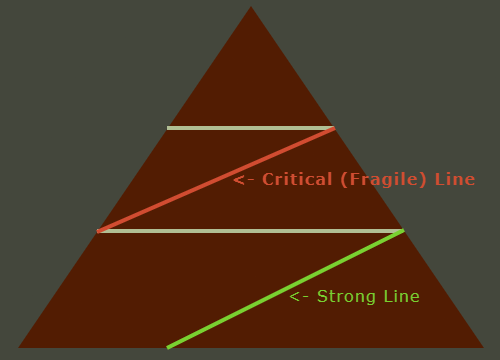
The interior of the other Pyramids was built with a different internal system, as if for a different purpose and with the appropriate strength. It should be noted that the Pyramid of Cheops is a symbol of a man, and three Small Pyramids on the side of the Pyramid of Menkaure are a symbol of children. By the way, the Pyramid of Menkaure (the so-called) is a symbol of the mother of the wife of Cheops (Pyramid of Cheops).
Geometry and mathematics are associated with wealth, love is separate from these three. Geometry and mathematics arose as a result of Creation, therefore geometry and mathematics cannot be the cause and source of Creation. The origin of the universe(s) cannot have technical theories, for example, the "Big Bang" theory is paradoxical, because human (and his mind) is a part of the universe, just as a human cannot see his own eyes without intervention. Figuratively speaking, a human can only puzzle out a bicycle.
As for the existence of aliens or Atlantis, this is complete nonsense, at least as shown in science fiction films or books.
Fourth, let's look at the composition of the Pyramids; Is it concrete or stone? Here, too, there is a mystery and a surprise; perhaps natural stones were also used and stones were created from concrete; both were used, depending on where it was needed. Making solid large slabs of concrete so that it do not crack (especially during concrete drying) is more difficult than processing natural stones. Let's say they deliberately complicated their work by creating stones from concrete.
Fifth, it is worth noting the skill of the builders: polygonal masonry, sculptures, paintings, hieroglyphs, statues, and dishes.
And as for the transportation and lifting of stones (provided that the Pyramids were built by people) from the quarry to the Pyramid and lifting the stone to the corresponding place in the Pyramid, this could be done with the help of a Hot Air Balloon(s). Such builders could also create a Hot Air Balloon.
 Marshal
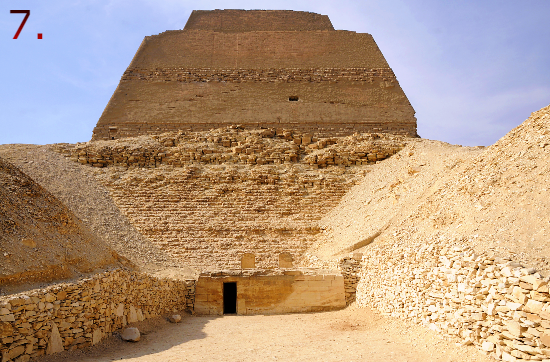
Type - Step pyramid
Height - 65 metres (213 ft) (ruined); would have been 91.65 metres (301 ft) or 175 cubits
Base - 144 metres (472 ft) or 275 cubits
Meidum, Maydum or Maidum (Arabic: ميدوم, Ancient Egyptian: Mr(y)-Jtmw, lit. 'beloved of Atum', Ancient Greek: Μοι(ε)θυμις) is an archaeological site in Lower Egypt. It contains a large pyramid and several mudbrick mastabas. The pyramid was Egypt's first straight-sided one, but it partially collapsed in ancient times. The area is located around 72 kilometers (45 mi) south of modern Cairo.
The pyramid at Meidum is thought to be just the second pyramid built after Djoser's and may have been originally built for Huni, the last pharaoh of the Third Dynasty, and continued by Sneferu. Because of its unusual appearance, the pyramid is called el-heram el-kaddaab – (False Pyramid) in Egyptian Arabic.
6. Bent Pyramid
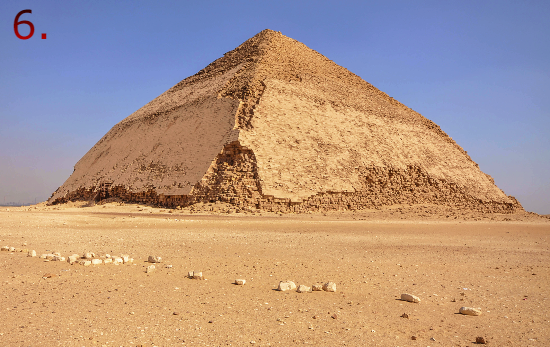
Type - Bent pyramid
Material - Limestone
Height - 104.71 metres (344 ft; 200 cu) 47.04 metres (154 ft; 90 cu) beneath bend 57.67 metres (189 ft; 110 cu) above bend
Base - 189.43 metres (621 ft; 362 cu) at base 123.58 metres (405 ft; 236 cu) at bend
The Bent Pyramid is an ancient Egyptian pyramid located at the royal necropolis of Dahshur, approximately 40 kilometers south of Cairo, built under the Old Kingdom Pharaoh Sneferu. A unique example of early pyramid development in Egypt was the second pyramid built by Sneferu.
The Bent Pyramid rises from the desert at a 54-degree inclination, but the top section (above 47 meters) is built at a shallower angle of 43 degrees, lending the pyramid a visibly 'bent' appearance.
5. Pyramid of Djoser
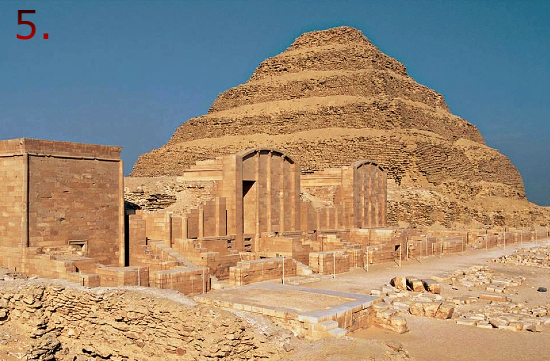
Type - Step pyramid
Material - Limestone
Height - 62.5 m (205 ft; 119 cu)
Base - 121 m (397 ft; 231 cu) by 109 m (358 ft; 208 cu)
The pyramid of Djoser (or Djeser and Zoser), sometimes called the Step Pyramid of Djoser, is an archaeological site in the Saqqara necropolis, Egypt, northwest of the ruins of Memphis. The 6-tier, the 4-sided structure is the earliest colossal stone building in Egypt.
4. Red Pyramid
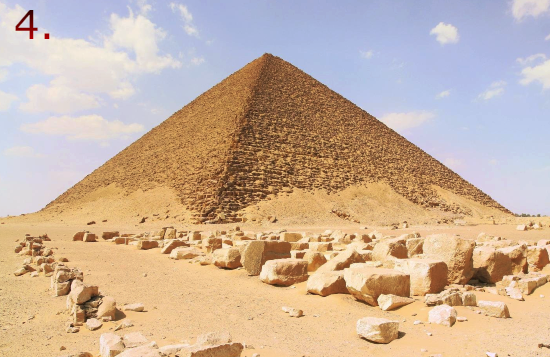
Type - True
Material - Limestone
Height - 105 m (344 ft; 200 cu)
Base - 220 m (722 ft; 420 cu)
The Red Pyramid, also called the North Pyramid, is the largest of the pyramids located at the Dahshur necropolis in Cairo, Egypt. Named for the rusty reddish hue of its red limestone stones, it is also the third largest Egyptian pyramid, after those of Khufu and Khafre at Giza. It is also believed to be Egypt's first successful attempt at constructing a "true" smooth-sided pyramid. Local residents refer to the Red Pyramid as el-heram el-watwaat, meaning the Bat Pyramid.
The Red Pyramid was not always red. It used to be cased with white Tura limestone, but only a few of these stones now remain at the pyramid's base, at the corner. During the Middle Ages, much of the white Tura limestone was taken for buildings in Cairo, revealing the red limestone beneath.
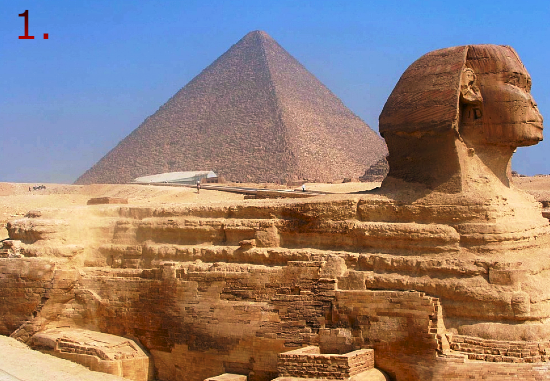
3. Pyramid of Menkaure
Type - True
Material - limestone, core red granite, white limestone, casing
Height - 65 metres (213 ft) or 125 cubits (original)
Base - 102.2 by 104.6 metres (335 ft × 343 ft) or 200 cubits (original)
The pyramid of Menkaure is the smallest of the three main Pyramids of Giza, located on the Giza Plateau in the southwestern outskirts of Cairo, Egypt. It is thought to have been built to serve as the tomb of the Fourth Dynasty Egyptian Pharaoh Menkaure.
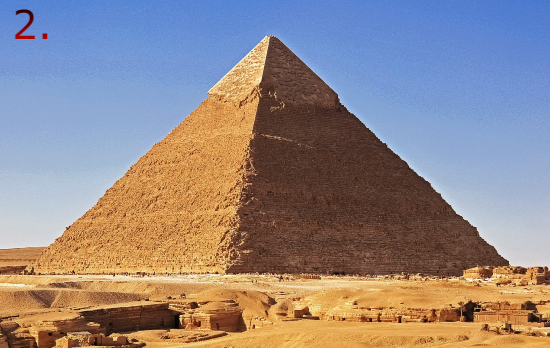
2. Pyramid of Khafre
Type - True
Height - 136.4 metres (448 ft) 143.5 m or 471 ft or 274 cu (original)
Base - 215.25 metres (706 ft; 411 cu)
The pyramid of Khafre or of Chephren (Arabic: هرم خفرع, romanized: haram ḵafraʿ) is the second-tallest and second-largest of the 3 Ancient Egyptian Pyramids of Giza, and the tomb of the Fourth-Dynasty pharaoh Khafre (Chefren).
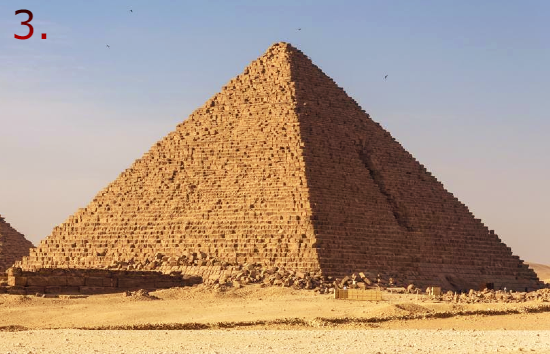
1. Great Pyramid of Giza - Pyramid of Khufu
Type - True
Material - Mainly limestone, mortar, and some granite
Height - 146.6 m (481 ft) or 280 cubits (originally) 138.5 m (454 ft) (contemporary)
Base - 230.33 m (756 ft) or 440 cubits
The Great Pyramid of Giza[a] is the largest Egyptian pyramid and the tomb of Fourth Dynasty pharaoh Khufu. It is the oldest of the Seven Wonders of the Ancient World, and the only one to remain largely intact. As part of the Giza pyramid complex, it borders present-day Giza in Greater Cairo, Egypt.
The Great Pyramid was built by quarrying an estimated 2.3 million large blocks weighing 6 million tonnes in total. Primarily local limestone from the Giza Plateau was used.
Tag Search

Ads
SubMeet


Ads

Rose

