
7 most famous/great Pyramids in Egypt from John's blog
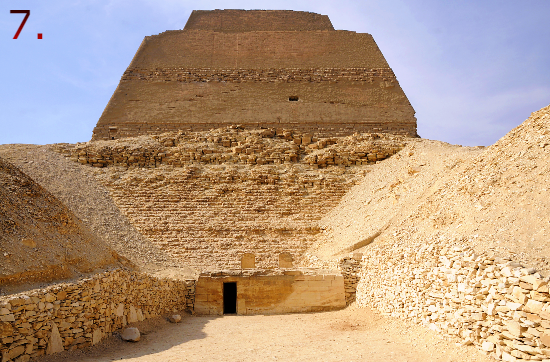
Type - Step pyramid
Height - 65 metres (213 ft) (ruined); would have been 91.65 metres (301 ft) or 175 cubits
Base - 144 metres (472 ft) or 275 cubits
Meidum, Maydum or Maidum (Arabic: ميدوم, Ancient Egyptian: Mr(y)-Jtmw, lit. 'beloved of Atum', Ancient Greek: Μοι(ε)θυμις) is an archaeological site in Lower Egypt. It contains a large pyramid and several mudbrick mastabas. The pyramid was Egypt's first straight-sided one, but it partially collapsed in ancient times. The area is located around 72 kilometers (45 mi) south of modern Cairo.
The pyramid at Meidum is thought to be just the second pyramid built after Djoser's and may have been originally built for Huni, the last pharaoh of the Third Dynasty, and continued by Sneferu. Because of its unusual appearance, the pyramid is called el-heram el-kaddaab – (False Pyramid) in Egyptian Arabic.
6. Bent Pyramid
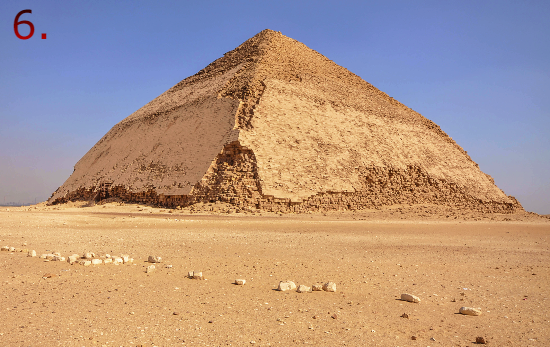
Type - Bent pyramid
Material - Limestone
Height - 104.71 metres (344 ft; 200 cu) 47.04 metres (154 ft; 90 cu) beneath bend 57.67 metres (189 ft; 110 cu) above bend
Base - 189.43 metres (621 ft; 362 cu) at base 123.58 metres (405 ft; 236 cu) at bend
The Bent Pyramid is an ancient Egyptian pyramid located at the royal necropolis of Dahshur, approximately 40 kilometers south of Cairo, built under the Old Kingdom Pharaoh Sneferu. A unique example of early pyramid development in Egypt was the second pyramid built by Sneferu.
The Bent Pyramid rises from the desert at a 54-degree inclination, but the top section (above 47 meters) is built at a shallower angle of 43 degrees, lending the pyramid a visibly 'bent' appearance.
5. Pyramid of Djoser
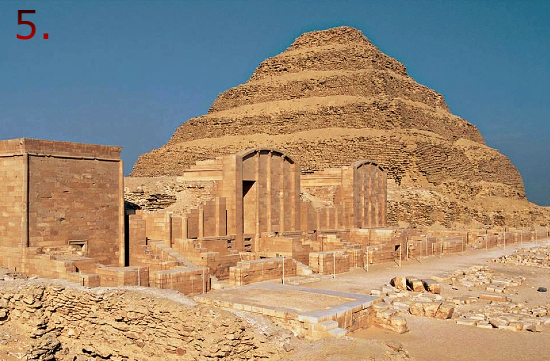
Type - Step pyramid
Material - Limestone
Height - 62.5 m (205 ft; 119 cu)
Base - 121 m (397 ft; 231 cu) by 109 m (358 ft; 208 cu)
The pyramid of Djoser (or Djeser and Zoser), sometimes called the Step Pyramid of Djoser, is an archaeological site in the Saqqara necropolis, Egypt, northwest of the ruins of Memphis. The 6-tier, the 4-sided structure is the earliest colossal stone building in Egypt.
4. Red Pyramid
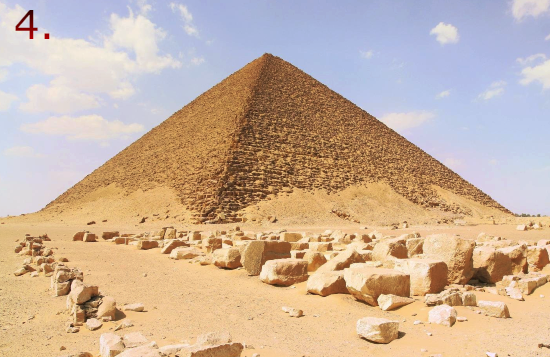
Type - True
Material - Limestone
Height - 105 m (344 ft; 200 cu)
Base - 220 m (722 ft; 420 cu)
The Red Pyramid, also called the North Pyramid, is the largest of the pyramids located at the Dahshur necropolis in Cairo, Egypt. Named for the rusty reddish hue of its red limestone stones, it is also the third largest Egyptian pyramid, after those of Khufu and Khafre at Giza. It is also believed to be Egypt's first successful attempt at constructing a "true" smooth-sided pyramid. Local residents refer to the Red Pyramid as el-heram el-watwaat, meaning the Bat Pyramid.
The Red Pyramid was not always red. It used to be cased with white Tura limestone, but only a few of these stones now remain at the pyramid's base, at the corner. During the Middle Ages, much of the white Tura limestone was taken for buildings in Cairo, revealing the red limestone beneath.
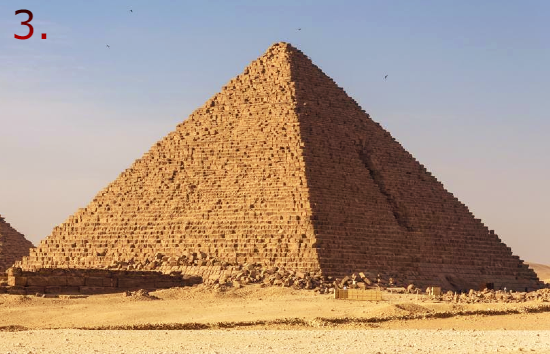
3. Pyramid of Menkaure
Type - True
Material - limestone, core red granite, white limestone, casing
Height - 65 metres (213 ft) or 125 cubits (original)
Base - 102.2 by 104.6 metres (335 ft × 343 ft) or 200 cubits (original)
The pyramid of Menkaure is the smallest of the three main Pyramids of Giza, located on the Giza Plateau in the southwestern outskirts of Cairo, Egypt. It is thought to have been built to serve as the tomb of the Fourth Dynasty Egyptian Pharaoh Menkaure.
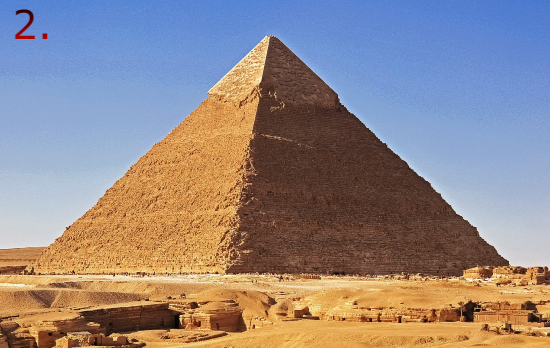
2. Pyramid of Khafre
Type - True
Height - 136.4 metres (448 ft) 143.5 m or 471 ft or 274 cu (original)
Base - 215.25 metres (706 ft; 411 cu)
The pyramid of Khafre or of Chephren (Arabic: هرم خفرع, romanized: haram ḵafraʿ) is the second-tallest and second-largest of the 3 Ancient Egyptian Pyramids of Giza, and the tomb of the Fourth-Dynasty pharaoh Khafre (Chefren).
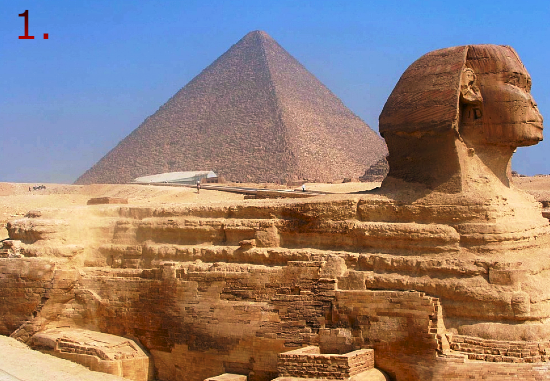
1. Great Pyramid of Giza - Pyramid of Khufu
Type - True
Material - Mainly limestone, mortar, and some granite
Height - 146.6 m (481 ft) or 280 cubits (originally) 138.5 m (454 ft) (contemporary)
Base - 230.33 m (756 ft) or 440 cubits
The Great Pyramid of Giza[a] is the largest Egyptian pyramid and the tomb of Fourth Dynasty pharaoh Khufu. It is the oldest of the Seven Wonders of the Ancient World, and the only one to remain largely intact. As part of the Giza pyramid complex, it borders present-day Giza in Greater Cairo, Egypt.
The Great Pyramid was built by quarrying an estimated 2.3 million large blocks weighing 6 million tonnes in total. Primarily local limestone from the Giza Plateau was used.

Ads
SubMeet


Ads

Rose


The Wall