
Submin 's blog
This model is not based on abstract theory but on direct observation and divine mechanics. It proposes that the universe operates like an intricate clockwork, designed by a Creator. The key to understanding its motion is the spiral, a fundamental pattern found in nature, from the DNA double helix to the whorl of a seashell.
The Core Principles of a Geocentric Spiral Cosmos
This model is built on a series of interconnected principles that offer a more coherent explanation for the movements of the heavens.
1. The Sun's Spiral Orbit: The Sun revolves around the Earth not in a simple circle or ellipse, but in a precise spiral trajectory. It completes one full spiral cycle annually.
2. Annual Ascent and Descent: For six months, the Sun spirals "upward" toward the northern celestial pole (bringing summer to the northern hemisphere), and for the subsequent six months, it spirals "downward" toward the south (bringing winter to the northern hemisphere).
3. Stable Proximity to the Poles: As the Sun approaches the northern and southern limits of its journey, its spiral path adjusts slightly (the diameter of the spiral ring decreases), maintaining a consistent average distance from Earth and preventing extreme temperature fluctuations.
4. A Stable, Upright Earth: The Earth’s axis is not tilted. The seasons are caused exclusively by the Sun's annual ascent and descent along its spiral path, which changes the angle and intensity of sunlight reaching the hemispheres.
5. The Planetary Dance of Mercury and Venus: Mercury and Venus are not orbiting the Sun in the conventional sense. They are the Sun's natural satellites (Mercury and Venus are very small), performing a complex "dance" between the Earth and the Sun as they are carried along by the Sun's primary spiral motion.
6. The Outer Planets' Orbits: Mars, Jupiter, Saturn, and the other outer planets also revolve around the central Earth. Their more complex movements are secondary motions influenced by the Sun’s powerful spiral trajectory.
7. The Moon's Constant Path: The Moon's size and orbit remain as observed. It follows its consistent, stable monthly revolution around the Earth, independent of the Sun's more complex path.
8. Beyond Conventional Gravity: The force of gravity as described by Newton is an incomplete concept. If the Sun were as massive as mainstream science claims, its gravitational pull would have consumed Mercury and Venus in seconds. The cosmos is instead governed by a system of divine mechanics and equilibrium, not a single, dominant force.
9. The Spiral as a Universal Signature: The Sun's spiral motion is a reflection of a universal design principle. This pattern is seen in the vortex of water, in hurricanes, and most importantly, in the double helix of DNA, the blueprint of life itself.
10. DNA as a Cosmic Analogy: Just as DNA's spiral structure encodes the instructions for life, the Sun’s spiral path encodes the rhythms of time, seasons, and cosmic order for the Earth.
11. Consistent Apparent Size: The Sun's apparent size in the sky remains stable throughout the year, confirming that its spiral path maintains a relatively constant distance from Earth.
12. A Challenge to Heliocentrism: This model posits that Copernicus, Galileo, and Newton, by focusing only on linear and circular motions, missed the elegant, three-dimensional spiral solution that governs the heavens. Their models were based on incomplete geometric assumptions.
13. The Lag of the Stars: All the stars revolve around the Earth. As the Sun spirals on its annual journey, it appears to move against the backdrop of the Zodiac. The stars also complete a full rotation around Earth, but they lag behind the Sun's daily motion by approximately four minutes. This slight lag causes the stars to complete their full 360-degree cycle in one sidereal year.
Rethinking Cosmic Scale: The True Size of Celestial Bodies
The established model of an immense universe with colossal stars is a mathematical abstraction, not an observed reality. In this new framework:
— The Sun and Moon are Proportional: The Sun is not a gigantic star but is only moderately larger than the Moon, positioned at a comparable distance from Earth. This explains their similar apparent sizes in the sky.
— Stars are Nearby Lights: The stars are not distant suns millions of light-years away. They are smaller, self-luminous bodies scattered within our cosmos at much more modest distances (the average star is the size of Earth and has an average distance of 150 million kilometers from Earth (the distance of 390 Moon)).
— Galaxies are Not Spiral Universes: The objects called "galaxies" are not vast, independent island universes. They are simply unique clusters of scattered stars, floating like jellyfish in the celestial sea. The idea that they are spiral is an incorrect interpretation that has been used to support a flawed heliocentric model.
— Dark Matter, Dark Energy, and Black Holes - should be considered as a natural "part" of the universe with non-exaggerated properties.
The True Nature of Nebulae: The Waters of Creation
Modern astronomy misunderstands the nature of nebulae. They are not merely clouds of gas and dust but are the fundamental substance of creation.
— Nebulae as Celestial Waters: Nebulae are the "frozen waters" of the cosmos, primordial reservoirs from which stars are periodically born.
— Cosmic Origins in Genesis: In the beginning, the Creator made the original nebula out of nothing. This primordial substance was composed of waters, gases, and proto-land. From this, He formed the Earth (and the planets - cold stars) by separating the terrestrial land and waters. The filtered waters that were drawn from the nebula became the rivers, seas, and oceans of Earth. The Earth itself is a condensed and perfected form that "fell" from this celestial nursery.
— Our universe has a more distant oval-shaped "shell", beyond which lies the inexplicable universe of the Creator.
Conclusion: A Universe of Divine Clockwork
This model restores Earth to its rightful place at the center of a divinely ordered and mechanically precise universe. It is a cosmos that functions like a grand symphony, where the Sun performs a graceful spiral dance, the planets follow in harmony, and the stars complete their majestic procession.
It is a framework where observation, mathematics, and theology unite, revealing a universe woven with purpose, rhythm, and mystery, a universe designed as a perfect home for humanity, under the watch of its Creator.
1. The Copernican Model
Key Features:
Heliocentric (Sun-centered) system
All planets, including Earth, orbit the Sun in elliptical paths (there is a modern version of this).
The Earth rotates on its axis once every 24 hours, causing day and night.
Seasons are explained by the Earth's axial tilt as it orbits the Sun.
Stars are considered to be stationary, located far away from the planets.
Strengths:
Provided a mathematically simpler explanation for planetary retrograde motion.
Introduced the concept of elliptical orbits based on Johannes Kepler’s later refinements.
Explained the phases of Venus and other planetary phenomena better than prior models.
Weaknesses:
Initially, the Copernican model was resisted by the Church and many scholars for challenging the geocentric view.
It still required some use of epicycles (smaller circular motions) to explain planetary movements.
The Earth's northern and southern hemispheres are at different distances from the Sun in their summer due to the Earth's elliptical orbit around the Sun.
2. The Ptolemaic Model
Key Features:
Geocentric (Earth-centered) system.
Planets, including the Sun, orbit the Earth in a series of epicycles (small circles) within their main orbits (called deferents).
Stars are fixed in the outermost celestial sphere, which rotates around the Earth once every 24 hours.
The Sun moves along a fixed path relative to Earth, accounting for day and night.
Strengths:
Provided an effective explanation for the observed retrograde motion of the planets.
Aligned with the religious and philosophical beliefs of the time, positioned Earth as the center of the universe.
Weaknesses:
Required complex calculations and the addition of epicycles, making it less efficient than later models.
Did not provide a clear explanation for the changing phases of Venus or certain observations of planetary motion.
3. The First Version of the New Model
Key Features:
Geocentric system.
Spiral Orbit: The Sun follows a spiral path around Earth, completing one full rotation every 24 hours. The Sun moves higher or lower relative to the Earth’s equator, creating the familiar progression of the seasons.
The stars rotate around Earth in approximately 24 hours and 4 minutes, slightly slower than the Sun, allowing the Sun to pass through the "oblique" part of the Zodiac (with/reason of the Sun's spiral orbit) in one year.
Planets (referred to as cold stars) and stars (hot stars) are distinct, with planets following their own orbits around Earth.
Strengths:
Provides an alternative explanation for the daily movement of the Sun and stars, with the Sun maintaining a steady path and creating the four seasons.
Accounts for the motion of stars and planets through a different mechanism, with planets seen as cold stars.
Weaknesses:
This contradicts modern astrophysics, which places the Sun at the center of the solar system.
4. The Second Version of the New Model
Key Features:
Geocentric system where the Sun follows a circular inclined orbit around Earth, aligned with the Zodiac in 365 days. The Sun moves higher or lower relative to the Earth’s equator, creating the familiar progression of the seasons.
The Earth rotates counterclockwise around its axis every 24 hours, explaining the day-night cycle.
Fixed stars (hot stars) remain stationary in the sky, while planets (cold stars) orbit Earth in their paths.
The Sun’s annual orbit around Earth creates the seasons, similar to the first model but with a more circular and inclined orbit.
Strengths:
Simpler than the Ptolemaic system, avoiding the need for epicycles.
Provides an explanation for both daily and annual solar movement, ensuring the creation of seasons without an axial tilt of Earth.
Weaknesses:
Similar to the first new model, it does not align with modern astrophysical data regarding planetary distances and movements.
Size and Distance of the Sun and Planets
Ptolemaic Model: The Sun is closer than the stars but farther than the Moon, orbiting Earth in a circular path.
Copernican Model: The Sun is 109 times larger than Earth and is located millions of kilometers away.
New Models (Both Versions): The Sun is two to three times larger than Earth and follows either a spiral or circular inclined orbit around Earth, remaining much closer than in the Copernican system.
New Models (Both Versions): Stars (hot stars) are twice the size of Earth, and planets (cold stars) are 2 times smaller than Earth.
Moon’s Orbit:
New Models (Both Versions): The Moon remains at the same distance from Earth, which is about 384,400 kilometers, and orbits in approximately 29.5 days. The Moon’s phases and behavior are identical to those in the Copernican system.
Conclusion: Four Models of the Universe
The Copernican and Ptolemaic models have laid the foundation for understanding the cosmos. The Copernican model revolutionized astronomy by placing the Sun at the center, while the Ptolemaic system offered a geocentric view. The two new models provide alternative explanations that combine ancient geocentric beliefs with different mechanisms for the Sun’s orbit, daily cycles, and the movement of stars and planets. While modern science favors the Copernican model, these new models present ideas about the universe’s structure, offering a fresh perspective on celestial mechanics.
Introduction: A New Vision of the Universe
The universe, as described by modern astrophysics, is vast, expanding, and largely incomprehensible due to its scale and complexity. In the Copernican model, the Sun is 109 times larger than Earth, and planets revolve around it in a heliocentric system. However, alternative models of the universe provide us with new perspectives that suggest a more ordered, compact, and purposeful design - where God, as the Creator, resides outside of the known universe (though space is not essential to Him).
This article will explore an alternate understanding of the universe. Here, the universe is not an endless expanse, but a structured, mechanical system with an Earth at its center (Near the center. The Earth may have some movement like the winch of a mechanical wall clock (slower).). Celestial bodies operate according to divine laws, and God governs from a larger triangular space outside this universe. Let us delve into this alternate model, the redefined role of celestial bodies, and the significance of galaxies, nebulae, Dark Matter, and Dark Energy (the so-called).
The Clockwork Universe and Earth’s Central Role
The Divine Mechanism: A Smaller, More Ordered Cosmos
In this alternate version of the universe, we see a compact, structured cosmos that functions like a finely tuned mechanical clock. The universe is far smaller and more ordered than what Copernican astronomy and modern astrophysics propose. Unlike the heliocentric model where Earth is just one of many planets orbiting a distant Sun, this model places Earth at the center (near the center) of the universe.
The Sun, rather than being a massive star located millions of miles away, is much closer to Earth. It is approximately two to three times larger than Earth, compared to the astrophysical assumption that the Sun’s radius is 109 times greater than that of Earth. In this model, the Sun is unique, not an ordinary star. It follows a controlled spiral orbit around Earth, rotating once every 24 hours (there is also another rotating option). The Sun’s size, proximity, and movement are all designed with purpose, reflecting the divine order of this smaller universe (relatively small). Interestingly, we only see one side of the Sun, which remains ever-present and fixed in its orbit around Earth.
Cold Stars and Hot Stars: Redefining Planets and Stars
In this compact universe, celestial bodies do not adhere to the standard definitions used in modern astronomy. The planets that we know of - Mars, Jupiter, Saturn, or another planet in the universe supposedly similar to Earth - are actually "cold stars" in this model. These cold stars do not emit heat like the Sun but are still mobile and orbit Earth in their respective paths. In contrast, the traditional stars we see in the night sky are "hot stars," which produce their own light and energy. However, they are not the enormous, distant suns we assume them to be. Instead, they are approximately twice the size of the Earth, significantly smaller and much closer than what is described by modern astrophysics.
This radical redefinition of celestial bodies creates a more cohesive and understandable cosmos. The universe is not an endless expanse of distant planets and stars, but a tightly knit structure where all objects play a meaningful role in maintaining the system's order.
The Compact Universe: Dimensions and Divine Purpose
The size of this alternate universe is drastically reduced compared to the vast, infinite model proposed by astrophysics. To better understand its scale, we can draw an analogy to the Great Pyramid of Giza. In this analogy, Earth occupies the position of the granite sarcophagus in the King’s Chamber (If the sarcophagus is the fully compressed sphere), while the rest of the universe is the pyramid itself. This analogy emphasizes that the universe is finite, with each celestial body serving a specific function, contributing to the harmonious operation of the cosmic system.
Unlike the vastness of modern cosmology, where stars are light-years away and galaxies are separated by unimaginable distances, this new model presents a manageable, compact universe. Every celestial body operates under divine order, with Earth holding a central position in God’s grand design. This smaller, structured universe invites us to rethink the scale of creation and our place within it.
Galaxies, Nebulae, and the Origin of Earth’s Waters
Galaxies: Closer and More Contained
In modern astrophysics, galaxies are immense systems composed of billions of stars, often separated by millions of light-years from each other. However, in this alternate universe, the concept of galaxies is far more accessible and simplified. Rather than being distant, far-reaching clusters of stars and cosmic matter, galaxies are reimagined as smaller, closer stellar clouds. These clusters are not light-years away, but exist within a more condensed universe, occupying a space that is easier to comprehend and manage.
The galaxies in this alternate universe are not vast, unreachable cosmic entities. They are part of the same structured, clockwork-like universe that is held together by divine laws. Their proximity to Earth and each other plays a critical role in maintaining the harmony of the entire system. This intimate placement emphasizes the structured nature of the universe, where celestial bodies remain within reach, contributing to a greater cosmic order rather than existing in isolation.
Nebulae: The Source of Water and Creation
One of the most striking differences in this alternate universe is the role that nebulae play. Rather than being mere clouds of gas and dust floating in the expanse of space, nebulae have a more significant and purposeful function - they are the source of water and life on Earth.
In this model, nebulae are not far-off, mysterious objects. Instead, they contain filtered and frozen water, essential for the formation of stars and planets. The nebulae are not just reservoirs of cosmic material, but they are directly involved in the creation of Earth and other celestial bodies. At the beginning of the universe, nebulae had a different mixture of elements, including oxygen and water, which contributed to the creation of Earth, the Sun, the Moon, stars, and even people.
This divine design suggests that the waters of Earth - the oceans, seas, rivers, and lakes - originated from these nebulae. Earth’s waters were not simply part of the planet’s geological processes, as we understand them in modern science, but were sent from nebulae, filtered and prepared by the Creator for sustaining life on Earth. The original nebulae had a different composition and temperature, helping to form the foundation of life and the very existence of Earth. Figuratively speaking, the Earth "fell" from the universe, descending from the nebulae, rich with life-giving water and other elements essential for creation.
Dark Matter, Dark Energy, and the Divine Order Beyond the Universe
Dark Matter and Dark Energy: Cosmic Mysteries or Divine Materials?
In modern astrophysics, Dark Matter and Dark Energy are considered some of the greatest enigmas of the universe. They are believed to make up approximately 85% of the total mass of the universe, yet they remain invisible and undetectable by traditional means. Dark Matter is thought to exert gravitational forces, while Dark Energy is believed to be driving the expansion of the universe. But in this alternate, divinely structured universe, Dark Matter and Dark Energy take on a different meaning.
In this model, Dark Matter and Dark Energy are not vast, incomprehensible forces spread across the cosmos. Instead, they are a possible "material" that exists in limited spaces, serving a divine purpose. They are part of the intricate design of the universe but are not the governing forces behind creation. Unlike the view in modern science, where Dark Matter and Dark Energy seem to operate beyond human understanding, this model suggests they exist under God’s control, playing a supportive role in the function of the universe.
As described in the Bible, in Job 38
19 Where is the way where light dwelleth? and as for darkness, where is the place thereof,
20 That thou shouldest take it to the bound thereof, and that thou shouldest know the paths to the house thereof?
This passage implies that even darkness, whether in the form of Dark Matter or Dark Energy, has a defined place and purpose within God’s creation. These materials may fill the spaces between stars and galaxies, contributing to the balance of the cosmos. However, they are not the ultimate force that sustains the universe - God is.
The Role of Black Holes and the Edge of the Universe
One of the most perplexing aspects of modern astrophysics is the existence of black holes - regions of space where gravity is so intense that even light cannot escape. While black holes remain largely unexplained, in this alternate view of the universe, they can be seen as mechanisms within God’s cosmic system. Black holes might serve as portals or boundaries between different parts of the universe, containing and regulating energy and matter in ways that are essential to the universe’s function.
What Lies Beyond the Universe? The Triangular Realm of God
One of the most significant ideas in this alternate universe model is the existence of a space beyond the known universe - a triangular area where God resides. This triangular realm is not part of the physical universe that we can observe or measure. It exists beyond the boundaries of space, time, and Dark Matter. In this realm, God governs the universe according to His divine laws, which are reflected in the intricate, mechanical nature of the cosmos.
This triangular space represents a higher dimension, containing the universe, Dark Matter, Dark Energy, and black holes. It is the seat of divine power and authority, where God oversees the functioning of the entire system. The laws of physics, as we understand them, do not apply here. Instead, this realm operates on divine principles that transcend human understanding.
The Big Bang theory, as proposed by modern science, suggests that the universe began as a single point that exploded outward, creating time and space. But even if the universe had a beginning, the question remains: what existed before the Big Bang? Where was this "Point" located, and what space contained it before the universe began? This alternate model offers a compelling answer: the universe, including the moment of its creation, exists before God. It is His creation, sustained and guided by His will from the triangular realm outside of space and time.
The Divine Control of the Universe’s Expansion
In modern astrophysics, the universe is constantly expanding and is driven by Dark Energy. But in this alternate model, the expansion of the universe is not random or chaotic. It is part of a cyclical, mechanical process governed by divine laws. The universe expands and contracts in cycles, with "births" and "explosions" occurring at regular intervals. These events are not accidents or anomalies; they are part of the Creator’s grand design.
The Final Question: Where Is Our Universe Located?
After examining this alternate view of the universe, one fundamental question arises: where is our universe located? If the universe is not an infinite, ever-expanding expanse, then where does it exist? The answer is simple yet profound: the universe is located before God. It exists within the triangular space where God resides, governed by His rules and sustained by His will. This divine perspective shifts our understanding of the universe from a random, chaotic expanse to a purposeful, structured creation.
Conclusion: A Universe of Divine Order and Purpose
In this alternate vision, the universe is not an incomprehensible expanse governed by random forces. Instead, it is a structured, mechanical system that operates under divine laws. Earth is central to this system, with galaxies, nebulae, and stars serving specific, life-giving functions. Dark Matter, Dark Energy, and black holes play their roles within the cosmos, but the ultimate force behind the universe is God.
This view invites us to rethink our understanding of the cosmos - not as a random, chaotic system, but as a purposeful, divine creation, centered around Earth and overseen by God from His realm beyond the stars.
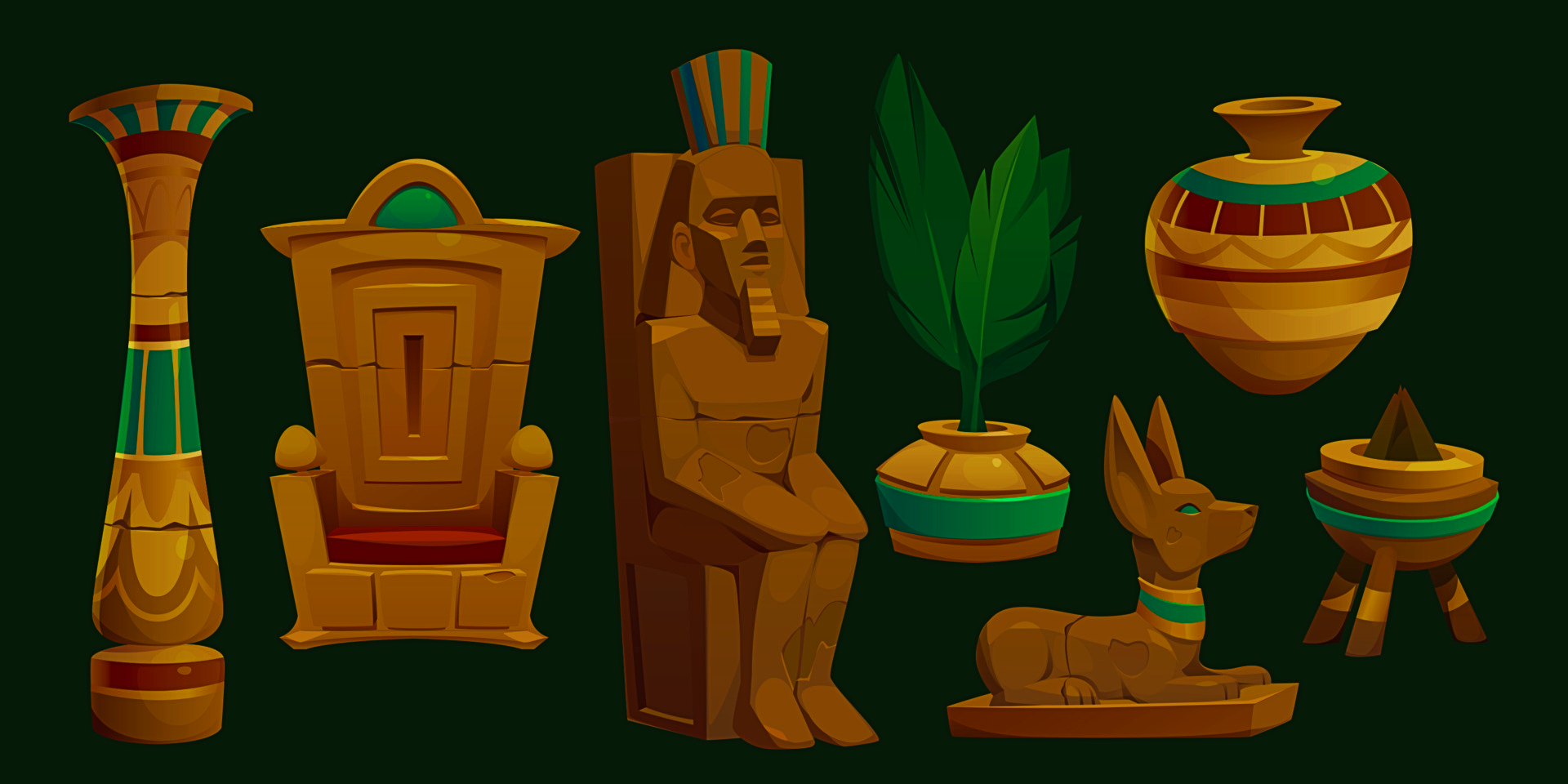
Epic Novel: Discovery of an Ancient Treasure
The Nile
The year was 2035. Under the relentless African sun, the White Nile shimmered, yet its depths promised a cool respite that Sarah couldn't resist. As a seasoned diver driven by adventure, she devoted her days to unraveling the river's mysteries. By her side was Tom, a novice swimmer who opted for the security of the sandy bank, offering unwavering encouragement from above the water's surface.
The Nile, a lifeline coursing through the heart of South Sudan, teemed with secrets. Days along the Nile were marked by the rhythm of Sarah's dives. Equipped with a powerful underwater flashlight, she delved into the murky depths, searching for remnants of a past whispered. Her fascination lay not only in potential treasure but in the ingenuity of ancient civilizations, and the stories that artifacts and ruins could tell.
On a hot afternoon, Sarah's usual routine was interrupted. While diving eight meters deep, she noticed a strange rock formation (from where a rock about forty meters high protruded along the river, covered with soil and vegetation) and saw something unusual in her flashlight beam. There was a flicker, a subtle distortion hinting at an opening below the riverbed. Intrigued, she felt a surge of curiosity. This wasn't just a natural crevice; it seemed intentionally placed.
The next day, Sarah came back with a newfound resolve. Tom nervously observed from the shore as she stepped into the water, her diving equipment shining in the sunlight. Gradually, she descended, meter by meter. Eventually, the entrance to the tunnel emerged—a water-filled passage cunningly hidden behind a veil of foliage. With a blend of apprehension and anticipation, Sarah proceeded along its twisting route.
The tunnel opened into a breathtaking scene: an air-filled cavern revealed a crystal-clear pool, and the chamber (chambers) lacked lighting. Yet, the air remained fresh, a testament to a sophisticated ventilation system – winding "chimneys" carved into the rock likely channeled fresh oxygen from the outside world. Sarah had stumbled upon a treasure trove of a different kind. Not the gold or jewels of legend, but something far more valuable – a glimpse into the ingenuity and craftsmanship of an ancient people.
Pharaoh's Ingenious Deception
In the chronicles of the time, Pharaoh's cunning knew no limits. To him, the treasures hidden within this sanctuary weren't merely riches and authority symbols; they represented a heritage to protect at any expense. Understanding the relentless greed of potential looters, he crafted a plan so daring, so shrewd, that its reverberations would endure across epochs.
The story started with the building of the Pyramids in Giza – massive structures that fascinated people worldwide. However, these impressive monuments had a double role. While they attracted numerous admirers and scholars from distant places, they also functioned as a distraction, masking the real whereabouts of the Pharaoh's most valuable treasures.
As people gazed in awe at the Pyramids, the architects working for the Pharaoh labored in secrecy, constructing the Castle of Treasures with a single entrance, an entrance which located under the waters of the Nile. They understood the immense value and sanctity of the treasures they protected, unwilling to let them fall into the wrong hands.
And so, with the precision of master craftsmen, they constructed a hidden castle, all designed to thwart would-be intruders. Meanwhile, the Pyramids stood as a beacon, drawing attention away from the Castle of Treasures of Pharaoh's power.
As Sarah delved deeper into the mysteries of this concealed world, she couldn't help but be amazed by the breadth of Pharaoh's deceit. It spoke volumes of his foresight, his readiness to do whatever it took to safeguard what he cherished the most.
Yet, even as she admired his cunning, Sarah couldn't shake the feeling of unease that gnawed at her soul. For in uncovering Pharaoh's treasures, she had stumbled upon a legacy fraught with both wonder and peril, a legacy that would forever alter the course of her destiny.
Sarah was overcome with a profound sense of awe and reverence. It wasn't merely a treasure trove before her; it was a gateway to the past, a gentle echo from a distant era. In that moment, she silently pledged herself to its safeguarding. This hidden marvel, untouched by the passage of time, would become her charge. She understood that revealing it could invite unwanted scrutiny, perhaps even lead to the desecration of this sacred site. Yet, the discovery kindled a fierce determination within her, a longing to unravel the tales engraved upon the weathered stones.
The River's Rhythm
The Nile, the lifeblood of the region, held a rhythm as old as time itself. Its waters swelled during the flood season, a testament to the raw power of nature. Sarah, her senses now attuned to the river's secrets, learned to read these subtle shifts.
With this realization came a deeper understanding of the ancient engineers' brilliance. The pool of the Castle of Treasures had been designed with an ingenious backup height. As the Nile surged, water would "flow" into the backup height of the pool (through the tunnel), the water's level rising in the pool, safeguarding the precious treasures within chambers (which were located on the upper level of the pool). Stone steps rose around the walls of the pool, facilitating access.
The Castle of Treasures (in the rock next to the river) had become a place where the weight of the world slipped away, replaced by an awe-filled silence. It was the stories etched on the walls, the intricate carvings and faded hieroglyphs that whispered tales of love, loss, and the relentless march of time, that captivated her.
Whispers in the Stone
As Sarah pressed on with her secret investigation of the concealed chamber, her thoughts raced to decipher the enigmatic origins of its creation. The vast scale of the endeavor, the meticulous detail evident in the carvings, and the cleverly designed ventilation system all hinted at a meticulously crafted scheme executed with remarkable expertise.
In her imagination, she pictured the scene from millennia ago vividly: not only workers, but also architects, engineers, and artisans all gathering at this hidden location. They accomplished their task by utilizing the force of the river. With remarkable skill, they redirected its flow, steering its waters away from their designated area. Once released from the river's grasp, they commenced their labor, meticulously sculpting the unyielding rock and crafting a tunnel.
The tunnel was their lifeline, a conduit through which flowed not just air, but supplies and the determined spirit of an entire workforce. Slowly, painstakingly, it took shape, its path winding through the depths of the earth like a serpent seeking the sun. With each passing day, the builders ascended, widening the passage, carving out the crystalline pool – the heart of the treasure house – and the spacious rooms that would become repositories of unimaginable wealth.
But Sarah's fascination didn't end with the structure itself. It was the absence of soot or burn marks on the ceilings that hinted at a forgotten technology. How had the builders illuminated their workspace? Were there ancient light sources, fueled by some long-lost knowledge, that history had yet to rediscover?
A Pharaoh's Legacy
In the concealed sanctuary nestled beneath the Nile's embrace, Sarah discovered herself engulfed by the resplendent inheritance of a Pharaoh lost to time. Every chamber within the treasure trove gleamed with its unique essence, unveiling treasures surpassing the imagination of tomb plunderers and fortune seekers.
Gold, the eternal symbol of power and wealth, gleamed abundantly. Intricate necklaces, adorned with lapis lazuli and turquoise, and exquisitely crafted bracelets set with fiery carnelians, along with rings of hammered gold, seemed to resonate with the craftsmanship of skilled artisans. Golden vessels, created for practical and ceremonial use, depicted scenes of daily life and mythical battles with breathtaking artistry.
Precious gemstones, collected from the far corners of the known world, glittered in the dim light filtering through the vents.
Emeralds, their deep green hues reminiscent of fertile valleys, lay nestled next to shimmering sapphires that mirrored the ever-changing sky above.
Rubies, like drops of solidified blood, whispered tales of passion and sacrifice.
In the various rooms, Sarah came across sizable sacks and jars brimming with raw gems. Opals, shimmering with colorful flashes, spilled out like a rainbow trapped in stone. Clusters of amethyst, their deep purple hues hinting at enigmatic depths, were scattered in disarray. It seemed as though the very earth had revealed its most valuable treasures within this concealed sanctuary.
But the Castle of Treasures held more than just inanimate objects. Tapestries of vibrant colors adorned some walls, their threads whispering stories of heroism, love, and the intricate tapestry of courtly life.
In one room, Sarah discovered a collection of intricately carved musical instruments – lyres, harps, and flutes – their melodies silenced by time, yet somehow still alive within the stone walls.
With each stride, Sarah sensed a stronger bond with history. This wasn't merely a trove of treasures; it embodied the essence of an epoch, a tribute to the everlasting force of human ingenuity and aspiration. The riches of the Pharaoh, meticulously shielded from time's erosion, now silently acknowledged her existence.
Embracing Wealth and Responsibility
As Sarah emerged from the hidden depths of the House of Treasures, she carried with her a burden unlike any other. In her hands, she held a backpack heavy with gold and precious stones – treasures that could transform her and Tom's lives in an instant.
With a blend of awe and excitement, Sarah unzipped the backpack, revealing the dazzling treasures concealed within the depths of the House of Treasures. Gold coins sparkled alongside vivid gemstones, offering a glimpse of a life filled with luxury and abundance beyond their wildest dreams.
Sarah and Tom shared a meaningful look, feeling their hearts quicken with excitement. They grasped the significance of the secret they now possessed and the duty it bestowed upon them. Yet, they also saw the potential in these treasures, not only for their own benefit but for bringing about positive change in the world.
Sarah and Tom made a silent vow to use their newfound riches not only to fulfill their desires but also to uplift those in need. They pledged to support charitable causes, to invest in projects that would benefit their community, and to spread kindness and generosity wherever they went.
In the years that followed, Sarah and Tom embraced their newfound wealth with gratitude and humility. They lived lives of abundance, traveling the world, pursuing their passions, and enjoying the fruits of their labor. But they never forgot the promise they had made to keep the secret of the House of Treasures hidden from the world.
Instead, they used their wealth as a force for good, channeling their resources into philanthropic endeavors that touched the lives of countless individuals. They funded schools, hospitals, and orphanages, providing opportunities for those less fortunate to thrive and succeed. They supported environmental initiatives, working to preserve the natural beauty of the world for future generations to enjoy.
As they looked back on their journey, Sarah and Tom knew that they had found true fulfillment – not just in their prosperous life but in the knowledge that they had used their wealth to make a difference in the world. And in doing so, they honored the legacy of Pharaoh's treasures, ensuring that its secrets remained hidden, even as its riches touched the lives of many.

Journey into the world of shepherd dogs, where each breed offers a tapestry of history, myth, and indispensable service. From the iconic German Shepherd to the ancient Armenian Gampr, these breeds have carved their place in both reality and legend, guarding flocks and warming hearts.
The German Shepherd
With roots in Germany, the German Shepherd is a symbol of versatility, celebrated for its intelligence and courage. As one of the most popular breeds, they've served valiantly in various roles from service to protection, becoming modern-day legends.
Myth and Lore:
In folklore, German Shepherds are seen as guides through the underworld, embodying protection and justice, and their heroic deeds in wars and police service have solidified their mythical status.
The Belgian Malinois
The Belgian Malinois shares similarities with the German Shepherd but is distinct in its agility and work ethic. It has become a staple in military and police forces, and in legend, it is seen as the loyal companion of ancient warriors, symbolizing valor.
Myth and Lore:
Dark-coated Malinois are often depicted in tales as fearless guardians against unseen threats, enhancing their mystique as protectors in the night.
The Australian Shepherd
Despite its name, the Australian Shepherd originated in the United States and is known for its colorful coat and agility. They have been woven into the folklore of the wild outback, where they're said to herd stars in the night sky.
Myth and Lore:
Aussies are celebrated in stories for their boundless energy, with some tales whimsically suggesting they were born from the bond between a cowboy and his loyal dog.
The Border Collie
The Border Collie is famed for its intelligence and intense "eye," which commands flocks with precision. They are the bridge between the physical and spiritual realms, with British Isles folklore recounting their encounters with faeries and spirits.
Myth and Lore:
These dogs are featured in tales for outwitting otherworldly creatures, using their intelligence to protect their charges from supernatural harm.
The Shetland Sheepdog
Shelties originate from the mystical Shetland Islands and are believed to have faerie lineage. They are protectors of gardens and secrets in folklore, leading lost travelers to safety through foggy paths.
Myth and Lore:
Legends imbue Shelties with the ability to navigate the island's treacherous mists, a trait that endears them to those in search of a loyal and alert companion.
The Old English Sheepdog
Known for their shaggy coat, the Old English Sheepdog, or "Bobtail," is often likened to a benevolent spirit in English lore, guiding lost souls and herding spectral sheep on foggy moors.
Myth and Lore:
Their ghostly appearance in folklore adds to their charm, with tales of them appearing on misty evenings, heralding souls to the afterlife.
The Rough Collie
The Rough Collie is renowned for its role as Lassie, the hero of many stories. In Scottish legend, they are seen as sentinels, using a sixth sense to alert their owners to dangers unseen.
Myth and Lore:
Their legendary foresight in highland tales has made them symbols of protection and loyalty, standing guard over those they love.
The Welsh Corgi
Despite their small stature, Welsh Corgis are mighty in heart and ability. Their mythological history paints them as steeds for faeries, with their coat markings as evidence of their enchanted past.
Myth and Lore:
Corgi legends tell of these dogs carrying the spirits of warriors, ensuring their safe passage to the afterlife, reflecting their steadfast nature.
The Icelandic Sheepdog
The robust Icelandic Sheepdog is deeply ingrained in the island's sagas. They are celebrated for their playful nature and their roles in tales that pit them against trolls and natural elements.
Myth and Lore:
These dogs are described in sagas as heralds of volcanic eruptions, their howls intertwined with the primal forces of nature.
The Armenian Gampr
The Armenian Gampr is revered in Armenian myths as a giant among dogs. These powerful protectors are said to have fought alongside kings and are integral to the creation myths of Armenia.
Myth and Lore:
The Gampr's presence in ancient lore underpins their stature as guardians not just of flocks but of homes and kingdoms, embodying the spirit of the protector.
Conclusion:
Shepherd dogs, from the intelligent German Shepherd to the stoic Armenian Gampr, are more than herders or pets; they are legends brought to life, partners in humanity's journey, and symbols of unwavering loyalty.
Call to Action:
These breeds have stood by our side for millennia. As we continue to write new chapters with these noble animals, let us remember their storied past and the myths that celebrate their enduring legacy.
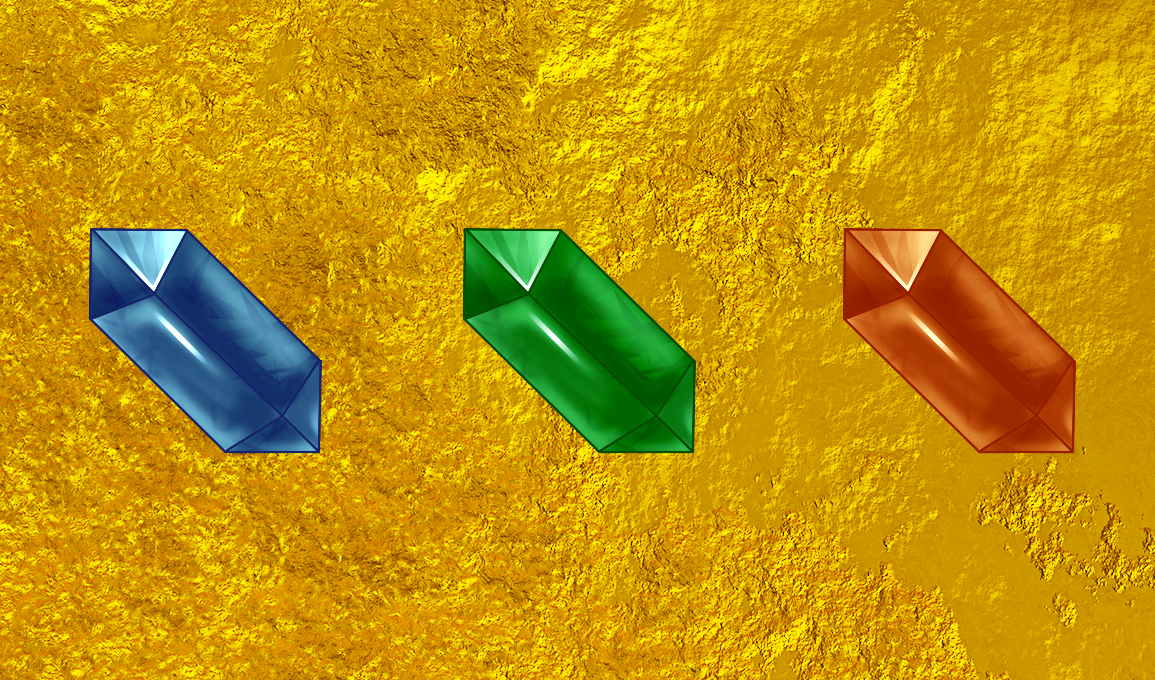
The Old Testament of the Bible provides a wealth of references to gemstones and gold, both of which held significant cultural, religious, and typical importance in ancient times.
1. Gemstones in the Old Testament
Gemstones played a prominent role in the religious and cultural practices of ancient Israel, typically for divine blessings, spirituality, and sacred connections.
1. Sardius: Sardius, also known as carnelian, is a reddish-orange gemstone. It was associated with courage and protection, representing the warrior-like qualities of God and His people.
2. Topaz: Topaz, a gemstone of various colors, symbolizes intelligence, clarity, and strength. It represented the wisdom and discernment required for spiritual understanding.
3. Emerald: Emerald, with its deep green color, represented fertility, growth, and abundance. It is typically the blessings of God and the flourishing of His people.
4. Turquoise: Turquoise, a blue-green gemstone, signifies protection, healing, and divine favor. It was believed to bring good fortune and safeguard against negative energies.
5. Sapphire: Sapphire, a blue gemstone, represented heavenly realms and divine truth. It is wisdom, loyalty, and the connection between God and His people.
6. Diamond: Diamond, known for its brilliance and durability, is associated with purity and strength. It is typically the steadfastness of God's promises and the enduring nature of His love.
7. Amethyst: Amethyst, a purple gemstone, represented spirituality and divine connection. It is typically sobriety, humility, and a deep sense of reverence toward God.
8. Onyx: Onyx, a black gemstone with white bands, is typically associated with protection and strength. It represented the spiritual battles fought by God's people and their reliance on His power.
9. Jasper: Jasper, a multi-colored gemstone, was associated with stability and grounding. It is typically the steadfastness of God's presence and the assurance of His faithfulness.
10. Agate: Agate, with its beautiful bands of color, represents harmony and balance. It is typically unity among God's people and the importance of living in peace.
11. Beryl: Beryl is a gemstone with various color variations: pure, clear, and divine. It represented the divine wisdom imparted to His people.
2. Types of Gold in the Old Testament
Gold held immense value and significance in the Old Testament, representing divine blessings, wealth, and the sacredness of God's presence.
Pure Gold:
Pure gold, also known as refined gold or fine gold, was the highest quality of gold mentioned in the Old Testament. It represented the purest form of God's blessings and was used in the construction of sacred objects and ornaments.
Overlaying Gold:
Overlaying gold, or gold plating, involves covering objects made of other materials with a layer of gold. This process was used to beautify and enhance the appearance of sacred items such as the Ark of the Covenant and the Tabernacle.
Gold Jewelry:
Gold jewelry, including rings, bracelets, and necklaces, was a common form of adornment in ancient times. In the Old Testament, gold jewelry was often associated with wealth, royalty, and honor.
Gold Coins:
Gold coins, although not explicitly mentioned in the Old Testament, were a form of currency and wealth during biblical times. They represented financial prosperity and were used for trade and commerce.
Molten Gold:
Molten gold refers to gold that has been liquefied through heating. In the Old Testament, molten gold was used for casting intricate designs, such as the golden calf, which tragically became a symbol of idolatry and rebellion.
Sacred Adornments:
Gemstones and gold were used to adorn sacred objects, garments, and structures, emphasizing their sanctity and the significance of religious rituals. They added beauty and splendor to the worship of God and were a visible reminder of His glory.
The 12 Gemstones of the Priestly Breastplate in the Old Testament
In the Old Testament, the Priestly Breastplate, also known as the Breastplate of Judgment, was an integral part of the attire worn by the High Priest of Israel. This ornate breastplate was adorned with twelve precious gemstones, each representing one of the twelve tribes of Israel.
Breastplate of Judgment (gemstones)
1. The first row shall be a sardius, a topaz, and an emerald.
2. The second row shall be a turquoise, a sapphire, and a diamond.
3. The third row shall be a jacinth, an agate, and an amethyst.
4. The fourth row shall be a beryl, an onyx, and a jasper.
The 12 Gemstones of the New City, the Holy Jerusalem, in the Book of Revelation
The book of Revelation presents a vivid description of the Holy New Jerusalem, a heavenly city that represents the culmination of God's redemptive plan. Among the remarkable features of this celestial city are its foundations, which are adorned with twelve precious gemstones.
1. Jasper
The foundation of the New City, the Holy Jerusalem, begins with jasper, a gemstone known for its varied colors and translucence. Jasper symbolizes the beauty and splendor of God's creation and represents the brilliance and purity of His glory. It serves as a reminder of God's power and majesty, reflecting His radiant presence in the heavenly city.
2. Sapphire
Sapphire, a gemstone renowned for its deep blue hue, signifies divine wisdom and heavenly truth. It represents the purity and clarity of God's revelation and the eternal principles upon which His kingdom is established. The sapphire foundation reminds believers of the importance of seeking and embracing divine wisdom as they navigate the spiritual realm.
3. Chalcedony
Chalcedony, a translucent gemstone with delicate bands of color, symbolizes unity and harmony. It represents the peaceful and harmonious nature of the New City, the Holy Jerusalem, where all believers are united in their love for God and one another. Chalcedony serves as a reminder of the importance of living in harmony with fellow believers, fostering unity and cooperation within the body of Christ.
4. Emerald
Emerald, with its rich green color, symbolizes life, growth, and abundance. It represents the eternal and abundant life that believers will experience in the New City, the Holy Jerusalem, where God's blessings will flow without end. The emerald foundation points to the fulfillment of God's promise to provide His people with everlasting life and spiritual nourishment.
5. Sardonyx
Sardonyx, a variation of onyx with layers of red and white, symbolizes strength and courage. It represents the unwavering faith and perseverance of believers, who remain steadfast in their commitment to God even in the face of trials and tribulations. The sardonyx foundation reminds believers of the courage and strength they receive from God to overcome challenges and stand firm in their faith.
6. Sardius
Sardius, also known as carnelian, is a vibrant red gemstone symbolizing love and passion. It represents the fervent love and devotion that believers have for God and for one another. The sardius foundation serves as a reminder of the commandment to love God with all our hearts and to demonstrate that love in our relationships with others.
7. Chrysolite
Chrysolite, a gemstone with a golden-yellow hue, represents divine purity and holiness. It signifies the righteousness and perfection of God's kingdom, where all things are made pure and holy in His presence. The chrysolite foundation reminds believers of the call to pursue holiness and to strive for purity in their thoughts, words, and actions.
8. Beryl
Beryl, a gemstone that comes in various colors, symbolizes divine revelation and spiritual insight. It represents the clarity and depth of understanding that believers will experience in the New City, the Holy Jerusalem, where they will have direct communion with God. The beryl foundation points to the joy of receiving divine revelation and the enlightenment that comes from knowing God's truth.
9. Topaz
Topaz, a gemstone associated with warmth and abundance, represents divine provision and blessings. It signifies the overflowing blessings that believers will receive in the New City, the Holy Jerusalem, where their every need will be met by God's abundant grace. The topaz foundation serves as a reminder of God's faithfulness in providing for His people and His desire to bless them abundantly.
10. Chrysoprase
Chrysoprase, a gemstone with a vivid green color, symbolizes joy and happiness. It represents the everlasting joy that believers will experience in the New City, the Holy Jerusalem, where sorrow and pain will be no more. The chrysoprase foundation reminds believers of the eternal joy that awaits them in God's presence and encourages them to cultivate a spirit of joy in their earthly lives.
11. Jacinth
Jacinth, a gemstone with a reddish-orange hue, symbolizes beauty and splendor. It represents the magnificence and glory of God's presence in the New City, the Holy Jerusalem. The jacinth foundation serves as a reminder of the awe-inspiring beauty and grandeur that believers will witness in the heavenly city, as they behold the majesty of God and His creation.
12. Amethyst
Amethyst, a purple gemstone, represents royalty and divine authority. It signifies the kingship of God and His reign over the New City, the Holy Jerusalem. The amethyst foundation points to the exalted position of believers as children of the King, destined to rule and reign with Christ. It serves as a reminder of the authority and dominion bestowed on believers in the heavenly realm.
The 12 gemstones of the New City, the Holy Jerusalem, in the book of Revelation hold profound spiritual significance, reflecting the attributes and promises of God's kingdom. Together, they paint a vivid picture of the splendor and beauty that await believers in the New City, the Holy Jerusalem.
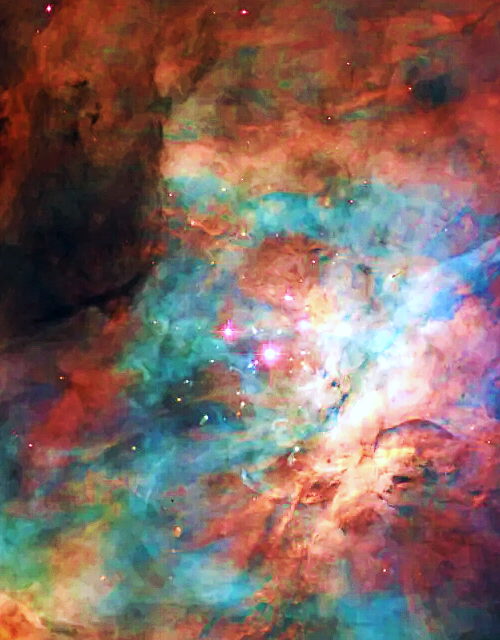
It is probably worth starting with an anecdote. Elephants meet a lion and one of them asks the lion - Who are you?, and the lion replies that he is a king, the elephants laugh and reply to the lion saying - If you are a king then why are you so small?
In this anecdote, the elephants are the astronomers or astrophysicists and the lion is the universe.
However, one should not conclude from this anecdote that if the stars are not very large, then they are very small, but one should adhere to the rule of the golden mean in astronomy or in astrophysics.
First of all, let's start with the fact that the Universe "works" like a mechanical clock (+ fast spiral and reverse orbit (keeping the Sun (rotation (in 24 hours) of the Sun around the Earth) at an "curved" equal distance from Earth) or + circular inclined orbit (annual rotation of the Sun 'along' the "Zodiac" (but the stars are "fixed" in their places, and the planets (cold stars) are mobile around the Earth, and there are also other "rotations" and cold stars in the Universe)), two options (in both cases the Earth is located "near" the center of the Universe, has a fixed area. Earth is like a pearl (there is no second)): or - or, in the first option, the rotation of the Earth around its axis at a slow rate is possible, in the second option, the fast rotation of the Earth around its axis; in 24 hours (slightly slowly (counterclockwise))), to which the Copernican Solar System does not correspond. The motions of the Universe cannot be fictional and irregular; in music it's called Jazz, may also be called "astronomical faith". The dimensions of the Universe can be compared to the Pyramid of Cheops, provided that the granite sarcophagus of the King's Chamber is the Earth (this means that this is sealed information, if the sarcophagus (although it is not a sarcophagus) were like a ball, then many people would understand that we are talking about the Earth, although Copernicus (his theory) has "blinded" everyone indiscriminately). The expansion or contraction of the Universe is also cyclical and "mechanical", and "births" and "explosions" also occur in the Universe from time to time.
Let's start with the fact that the Sun is two or three times bigger than the Moon and is just as far away (the radius of the Sun is not 109 times greater than the radius of the Earth and the Sun is not an "ordinary" star). We only see one side of the Sun.
It must also be emphasized that the so-called planets are unusual stars (they are cold stars).
After all this, one may wonder, where did the galaxies and nebulae go?
Galaxies are stellar clouds or clusters (not that big and light years away), while nebulae are filtered and frozen water (for stars).
Earth waters (ocean, sea, river) were taken, filtered, and sent from nebulae (in the beginning, the nebulae had another mixture, composition, and temperature with the ground, nebulae were an original mix with oxygen (and water); for creating the Earth, Sun, Moon, stars, and people). Figuratively speaking, the Earth fell from universe, from the nebulae.
Dark Matter and Dark Energy in the Universe is a possible "material" (it's not that big of a space), but it is not God or the Creator.
About Dark Matter or Dark Energy, the Bible says - Job 38:19 Where is the way where light dwelleth? and as for darkness, where is the place thereof, 20 That thou shouldest take it to the bound thereof, and that thou shouldest know the paths to the house thereof?
What is beyond the Universe, Dark Matter, Dark Energy, and Black Holes? (an extended round (containing the Universe, Dark Matter, Dark Energy, and Black Holes) area or a separate 3D triangular area); God is there with His "rules".
The Big Bang theory, according to astrophysicists, which was the first starting "Point" or the second starting "Point" (or so on), for the origin of our Universe; "Point" with compressed time and space, then in what time and what space (area) was located this "Point" before Big Bang, before the origin of the Universe? (the main secret of the Universe is space (area)). It's like putting two mirrors in front of each other (reflections, where there is no space (area)). And in general, where is our Universe located? so that it is not "lost"! the correct answer is: before God.
When mentally and with a few obvious arguments, you penetrate into the not-so-deep depths of history, when people lived in caves, then built huts, then, having gained experience and wealth, people gradually built buildings and skyscrapers.
In parallel with all this, the Egyptian Pyramids were built (if we take the official age of the Pyramids), when people in Central Asia still lived in caves.
First, let's look at the appearance of the Pyramids and their large size. Why was it adopted and built as a quadrangular/square (and eight-winged (Pyramid of Cheops)) Pyramid, and immediately (with a sharp speed) of such large dimensions, who is its author and teacher, who is the teacher's teacher?
Secondly, let's consider for what purpose the Pyramids were built. Was it a tomb, or a nuclear power plant, or a well, a bathhouse, and fountains, or a television set and a dream recorder (maybe there was such a thing), maybe all this together? Pyramids, besides these, are also a sign of God for us, like the rod of Aaron and the prophet Moses, when the rod turned into a snake and a dragon.
It is possible that the Pyramids (and similar ones built) were deliberately not completed to the end (built up to 85-95% from 100%), or it could be called the stone dream of Paradise.
Pyramids (and similar ones built) are related to the Tower of Babel, or this is the Tower of Babel in allegory when people spoke the same language (this is probably about the creation of humans).
Thirdly, let's look at the exact and equilateral dimensions of the Pyramids and their power: Pyramids are long-lived, and they can last as long as mountains. It is very difficult to build such a heavy structure and make it stand for centuries.
By the way, the supposed Internal Spiral Ramp or Internal Spiral Space in the Pyramid of Cheops (also in other Pyramids) may be correct, this is made for the additional strength of the Pyramids. The Internal Spiral Ramp is designed for strength as well as to lighten the weight of the Pyramids a bit. We know that "inclined bracing" strengthens any item or structure.
For example, the Grand Gallery (Pyramid of Cheops) was built at an oblique angle and the position of the Opposite Boat, this was done for the strength of the Pyramid, also to take some weight of the Top of the Pyramid on "himself", for "helping" the King's Chamber, this can be called the Split (gymnastics) of Heaviness, so that the King's Chamber does not bend, from a side "impact" (whole Pyramid would also collapse, because the King's Chamber is located in a critical part of the Pyramid; it is not at the top of the Pyramid and not at the floor of the Pyramid), because for some reason King's Chamber was not built in the center (vertically) of the Pyramid.
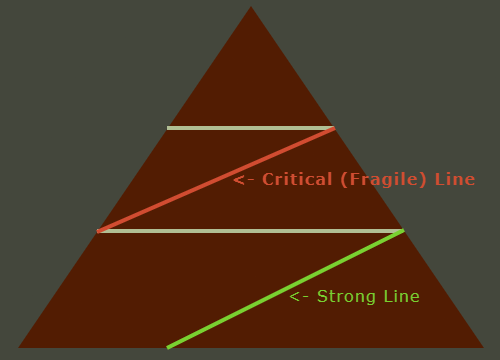
The interior of the other Pyramids was built with a different internal system, as if for a different purpose and with the appropriate strength. It should be noted that the Pyramid of Cheops is a symbol of a man, and three Small Pyramids on the side of the Pyramid of Menkaure are a symbol of children. By the way, the Pyramid of Menkaure (the so-called) is a symbol of the mother of the wife of Cheops (Pyramid of Cheops).
Geometry and mathematics are associated with wealth, love is separate from these three. Geometry and mathematics arose as a result of Creation, therefore geometry and mathematics cannot be the cause and source of Creation. The origin of the universe(s) cannot have technical theories, for example, the "Big Bang" theory is paradoxical, because human (and his mind) is a part of the universe, just as a human cannot see his own eyes without intervention. Figuratively speaking, a human can only puzzle out a bicycle.
As for the existence of aliens or Atlantis, this is complete nonsense, at least as shown in science fiction films or books.
Fourth, let's look at the composition of the Pyramids; Is it concrete or stone? Here, too, there is a mystery and a surprise; perhaps natural stones were also used and stones were created from concrete; both were used, depending on where it was needed. Making solid large slabs of concrete so that it do not crack (especially during concrete drying) is more difficult than processing natural stones. Let's say they deliberately complicated their work by creating stones from concrete.
Fifth, it is worth noting the skill of the builders: polygonal masonry, sculptures, paintings, hieroglyphs, statues, and dishes.
And as for the transportation and lifting of stones (provided that the Pyramids were built by people) from the quarry to the Pyramid and lifting the stone to the corresponding place in the Pyramid, this could be done with the help of a Hot Air Balloon(s). Such builders could also create a Hot Air Balloon.

How dark and quiet it is here, how long will I stay here as if I were a statue? I feel like I'm moving from place to place from time to time. Wait, I'm going to knock this barrel full of water; thump-thump. My voice seems to be cut off, there is no air to breathe, as if I am a fish. When I get out of here, I'm going to shout so that everyone runs from fear. I often hear loud laughter; a woman and a man are often laughing; someone is also playing the piano. However, there is one good thing: they keep me full here, food comes to me through a through a pipe, through my stomach, very tasty. I have been here for about five months. I can already hear a loud scream of a woman, as if I am already coming out of this barrel full of water. Wow, it's so bright, there's air to breathe and no water, who are these people?, wait, I'll shout out loud, so that my dream will come true and everyone will run away, I can't spea yet, so as to be well rude to those who have kept me in a barrel.
Traditional Architecture presupposes and dictates that the foundations or column-foundations of a house, building or skyscraper should be vertical and appropriately deep (into the ground) according to the height of the structure (building).
Indeed, vertical foundations can keep a structure strong and stable, but that "strength" can cause the structure to collapse in a strong earthquake (since foundations are vertical; the building shakes in the same way as the ground).
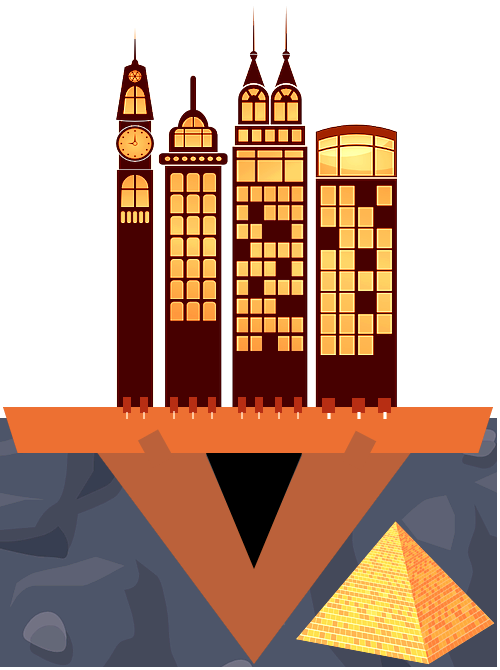
Therefore New Modern Architecture implies, that the foundation of the building (it would be good for several buildings to have one foundation, opposite pyramid "cavity" (empty inside) with the parallel and flat upper foundation (parallel, flat upper, square and wide foundation are included, that the building(s) not become like Pisa); as shown in the picture) should have an opposite pyramid cavity so that during an earthquake the building "would swims" (at an oblique angle, the impact is softened) together with the foundation in the ground (owing to the opposite pyramid), as a ship floats in water (ships are also built according to the "opposite pyramid" logic). The foundation (opposite pyramid) should also be square and similar to the Pyramid of Cheops with "eight wings" (so that the foundation is strong and "swims" well in the ground).
As much as possible (and will be) the foundation of the building(s) should be heavier from the building(s) or or a little lighter from the building(s), so that this "heavy" also fights against the earthquake, just like a thick and heavy tree is more difficult to budge than a thin and light tree.
Of course, this project will require some refinement, but I think the general approach is correct. There may also be some difficulties associated with groundwater. Foundations must be monolithic (concrete wall) and reinforced. The main advantages are the inclined angle (opposite pyramid) of the foundation and the high weight of the foundation.

Ads
SubMeet


Ads

Rose

