
SubMeet Blog Posts
Write your:
Biography, story, article or tidings.
Maximum 50.000  symbols (Depends on the browser) one post.
Maximum 10 posts per day, 100 posts per month, for one user.
We recommend using the Firefox browser to publish a post.



 Marshal
Delve into the mysteries of the Hall of Mandapa at Amritapura and Chennakeshava Temple. Explore their unique construction, influenced possibly by other ancient civilizations.
Join us on a captivating journey through India's historical landscape as we explore the Hall of Mandapa at Amritapura and the Chennakeshava Temple. These architectural masterpieces are important not only for their spiritual relevance but also for the intriguing possibility of cross-cultural influences in their construction.

The Hall of Mandapa at Amritapura: A Confluence of Architectural Styles
Diving into History: Structure and Significance
The Hall of Mandapa is an integral part of the Amrutesvara Temple. Renowned for its detailed carvings and majestic pillars, the hall epitomizes the zenith of ancient Indian temple architecture. Famed for its intricate carvings, the hall could reflect a synthesis of Indian and potentially foreign architectural styles.
Cross-Cultural Stone Processing and Transportation Techniques
The use of soapstone suggests traditional Indian craftsmanship, possibly complemented by techniques from other civilizations. The logistical expertise of transporting massive stone blocks, possibly over great distances, illustrates the advanced engineering of the era. The stone transportation methods may have been inspired by or adapted from ancient engineering practices seen in other parts of the world.
Interweaving Myths and Global Architectural Influences
Myths surrounding the temple's construction hint at not just divine intervention but also the infusion of ideas from distant lands. Researchers speculate about the influence of other ancient civilizations on the temple’s design and construction techniques.
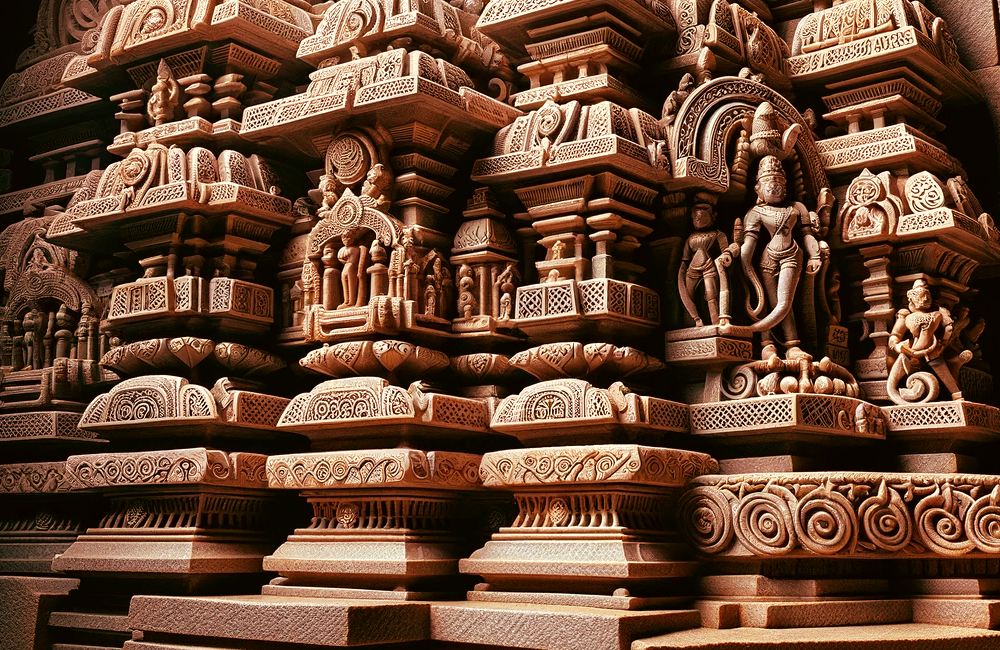
The Chennakeshava Temple: A Mosaic of Global Architectural Wisdom
An Artistic and Engineering Marvel
Located in Belur, the Chennakeshava Temple is a testament to the ingenuity of the Hoysala Empire. The temple’s design, while deeply rooted in Indian tradition, might also exhibit influences from other ancient cultures.
Entwined with Myths and Construction Mysteries
Enveloped in local legends, the temple's construction is often attributed to divine intervention or mysterious, lost techniques. Modern research continues to explore the innovative methods used in erecting this architectural marvel.
Fusion in Stonework and Artistic Endeavors
The diverse shapes and detailed carvings of the temple stones suggest a blend of local and possibly foreign artistic influences. The meticulous craftsmanship may reflect a confluence of Indian and external architectural philosophies.
Constructive Legends and Theories of International Collaboration
The prolonged construction period of the temple raises questions about the extent of cultural exchanges and collaborative efforts with other civilizations. Theories abound regarding the temple's design principles, possibly incorporating knowledge shared across borders in ancient times.
Celebrating the Global Heritage in India’s Architectural Wonders
The Hall of Mandapa at Amritapura and the Chennakeshava Temple are not merely historic Indian structures but are possibly the result of a rich tapestry of international architectural influences. These temples stand as a testament to the interconnectedness of ancient civilizations and their shared contributions to architectural history. As we uncover the layers of history embedded within their walls, we gain a deeper appreciation for India's rich architectural heritage.
 Admin
AdminTraditional Architecture presupposes and dictates that the foundations or column-foundations of a house, building or skyscraper should be vertical and appropriately deep (into the ground) according to the height of the structure (building).
Indeed, vertical foundations can keep a structure strong and stable, but that "strength" can cause the structure to collapse in a strong earthquake (since foundations are vertical; the building shakes in the same way as the ground).
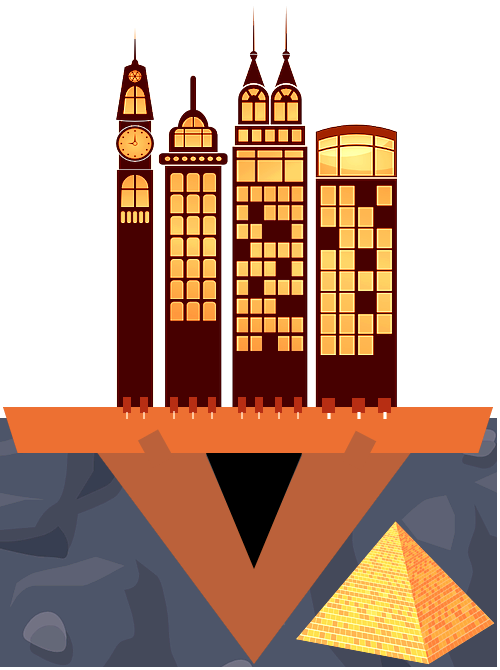
Therefore New Modern Architecture implies, that the foundation of the building (it would be good for several buildings to have one foundation, opposite pyramid "cavity" (empty inside) with the parallel and flat upper foundation (parallel, flat upper, square and wide foundation are included, that the building(s) not become like Pisa); as shown in the picture) should have an opposite pyramid cavity so that during an earthquake the building "would swims" (at an oblique angle, the impact is softened) together with the foundation in the ground (owing to the opposite pyramid), as a ship floats in water (ships are also built according to the "opposite pyramid" logic). The foundation (opposite pyramid) should also be square and similar to the Pyramid of Cheops with "eight wings" (so that the foundation is strong and "swims" well in the ground).
As much as possible (and will be) the foundation of the building(s) should be heavier from the building(s) or or a little lighter from the building(s), so that this "heavy" also fights against the earthquake, just like a thick and heavy tree is more difficult to budge than a thin and light tree.
Of course, this project will require some refinement, but I think the general approach is correct. There may also be some difficulties associated with groundwater. Foundations must be monolithic (concrete wall) and reinforced. The main advantages are the inclined angle (opposite pyramid) of the foundation and the high weight of the foundation.
Tag Search

Ads
SubMeet


Ads

Rose

