
SubMeet Blog Posts
Write your:
Biography, story, article or tidings.
Maximum 50.000  symbols (Depends on the browser) one post.
Maximum 10 posts per day, 100 posts per month, for one user.
We recommend using the Firefox browser to publish a post.



 Marshal
In the final book of the Holy Book, a striking vision appears before the heavenly throne: seven burning lamps, explicitly identified as the seven Spirits of God. Yet the Holy Spirit is one. Why, then, is the Spirit described through the number seven?
The answer is not that God is divided into seven separate spirits. Rather, the biblical tradition presents the one Holy Spirit through a sevenfold pattern of divine operation. This pattern appears in prophetic literature, develops through historical narratives, and reaches its fullest symbolic expression in Revelation.
The Sevenfold Foundation
Isaiah 11:2 lays the foundation, where the Spirit rests upon the righteous Branch from the root of Jesse. In the ancient Greek translation, the passage presents a structured sevenfold description:
1. Wisdom, the ability to perceive divine reality and eternal truth.
2. Understanding, the capacity to discern and interpret what is revealed.
3. Counsel, the wisdom to make righteous decisions and provide direction.
4. Might, the strength required to accomplish divine purpose.
5. Knowledge, an intimate awareness of divine truth.
6. Godliness, sincere devotion expressed through faithful living.
7. Fear of the Lord, reverence and awe that keep the human heart rooted in humility before God.
These are not seven separate spirits. They are seven dimensions through which the one Spirit operates. Together they form a complete spiritual pattern.
Why Do Other Spiritual Manifestations Appear?
The wider biblical narrative introduces additional manifestations. Bezalel, for example, is filled with the Spirit of God for artistic craftsmanship and the construction of the Tabernacle. Prophecy appears repeatedly as a manifestation of divine inspiration. Samson receives extraordinary strength and courage.
At first glance, this seems to create a numerical problem. If Scripture describes artistic skill, prophecy, courage, and other abilities, why does the prophetic and apocalyptic tradition emphasize seven?
The key is to distinguish foundational gifts from their practical manifestations.
Artistic craftsmanship does not necessarily represent an eighth gift. Exodus describes Bezalel as receiving wisdom, understanding, and knowledge for his work. His extraordinary craftsmanship can therefore be understood as these foundational gifts operating in a particular sphere.
Likewise, supernatural strength and heroic courage belong naturally to might. Physical strength, moral endurance, and courageous action can all express the same underlying spiritual capacity.
Prophecy, Power, and the Spirit in Joel and Micah
The prophetic books of Joel and Micah provide further evidence that the Spirit’s manifestations should not necessarily be counted as separate spiritual gifts. Joel describes a future outpouring of God’s Spirit upon all people, resulting in prophecy, visions, and dreams. The emphasis is not on a new category of spiritual power, but on the Spirit Himself becoming active through different forms of revelation. Micah offers an especially striking example: the prophet declares that he is filled with power, with the Spirit of the Lord, together with justice and might, in order to proclaim Israel’s sin. Here, prophetic proclamation, spiritual power, courage, and justice operate together as expressions of the Spirit’s activity rather than as unrelated gifts. These passages strengthen the idea that prophecy and supernatural power are practical manifestations of the Spirit’s deeper foundational dimensions.
Seven Roots, Many Expressions
The pattern can therefore be summarized as follows:
1. Wisdom expresses itself through creative and intellectual insight.
2. Understanding enables analysis, discernment, and practical mastery.
3. Counsel provides righteous direction and strategic guidance.
4. Might appears as strength, courage, endurance, and decisive action.
5. Knowledge supports revelation and understanding of divine truth.
6. Godliness produces devotion, worship, and faithful conduct.
7. Fear of the Lord preserves humility and reverence before God.
The apparent expansion is therefore not necessarily an expansion in the number of spiritual roots. It is the sevenfold Spirit expressing Himself through different circumstances and human capacities.
Grace Is Not an Eighth Gift
Another source of confusion is the word grace. Should grace itself be counted as another spiritual gift?
No. Grace is a broader category, not another item within the category.
The distinction is similar to the relationship between color and individual colors. Red, blue, and green are colors, but color itself is not another color added to the list.
In the same way, divine grace is the universal source and medium through which spiritual gifts operate. Wisdom, knowledge, might, counsel, and the other gifts are particular expressions of divine grace rather than additions to it.
This distinction helps explain why the biblical language can speak of many manifestations while retaining a coherent sevenfold structure.
Why Seven Spirits?
The Book of Revelation brings this pattern into its most powerful symbolic form. Seven lamps burn before the throne, and the vision identifies them as the seven Spirits of God. Elsewhere, seven eyes appear upon the Lamb.
The number seven in biblical symbolism frequently communicates completeness, fullness, and perfection. The image therefore need not imply seven independent spirits. It can signify the fullness of the one Spirit in His complete operation.
The picture is like white light passing through a prism. The light remains one, yet it appears through a complete spectrum of distinct colors. Similarly, the Holy Spirit is one, while His operation can be perceived through wisdom, understanding, counsel, might, knowledge, godliness, and fear of the Lord.
The sevenfold pattern therefore connects prophetic promise, historical manifestation, and apocalyptic vision, revealing a deeper unity beneath what may initially look like a scattered collection of supernatural abilities.
The Spirit is one. The manifestations are many. The sevenfold pattern expresses their fullness and reveals their shared source.
 Moder
ModerI AM THAT I AM
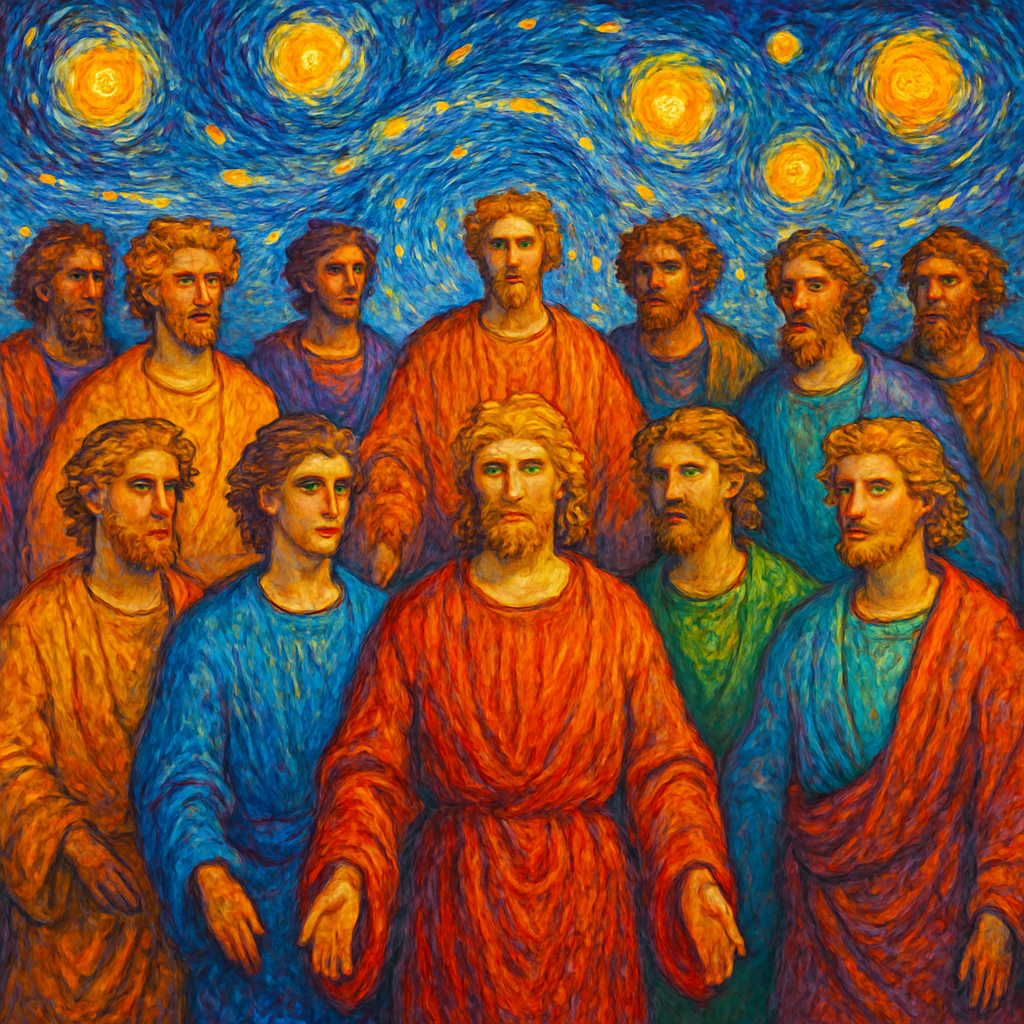
In studying the Holy Book and theology, few topics cause as much misunderstanding as God's name. One of the most sacred and powerful words in Scripture is YHWH (Hebrew: יהוה), often called the Tetragrammaton, meaning "four letters." But what does this name really mean? How is it used in different Bible versions? And why isn’t it tied to any specific religious group, like the Jehovah’s Witnesses, despite widespread confusion?
This article explores the meaning, translation, and spiritual significance of the divine name YHWH, while clearing up common modern misconceptions.
What Is YHWH?
YHWH is God's name revealed in the Hebrew Bible. It comes from the Hebrew verb "היה" (hayah), which means "to be" or "to exist." In Exodus 3:14, when Moses asks God His name, the reply is:
"Ehyeh Asher Ehyeh" – "I AM THAT I AM"
This directly links to YHWH, showing that God is:
Self-existent
Uncreated
Eternal
The source of all being
In short:
YHWH is an explanatory name, not a personal label like a human name.
It means:
"The One Who Is" – The Eternal Creator
Not a name given by parents, but the identity of the One who exists without beginning or end.
How Is YHWH Represented in Four Key Biblical Traditions?
The divine name YHWH appears differently across traditions and translations:
Masoretic Text (MT)
The traditional Hebrew Bible, preserved by Jewish scribes, writes the name as יהוה, but Jewish readers substitute it with Adonai (“Lord”) when reading aloud out of respect.
Septuagint (LXX)
This ancient Greek translation replaces YHWH with Kyrios (Lord), losing the personal name but maintaining a sense of authority.
King James Version (KJV)
This early English translation largely avoids "Jehovah" and instead uses LORD in all caps to show the divine name without pronouncing it. "Jehovah" appears in only a few verses.
Dead Sea Scrolls
These ancient Hebrew manuscripts from Qumran (around the 2nd century BCE) do preserve YHWH fully. In some scrolls, it is even written in Paleo-Hebrew script to set it apart and demonstrate reverence.
What About “Jehovah”? Is It the True Name of God?
No.
The word “Jehovah” is a medieval invention, mistakenly formed by combining the consonants of YHWH with the vowels of Adonai. The result was YeHoWaH, later Latinized as Jehovah.
While common today, this word is:
Linguistically incorrect
Historically absent from any ancient manuscript
Never spoken or written by Hebrew prophets.
Is YHWH Connected to Jehovah’s Witnesses?
Many believe that YHWH (or Jehovah) is primarily or exclusively associated with Jehovah’s Witnesses (a church that has no statehood), a religious group that emerged in the 19th century. This is not only wrong but also downplays the historical and theological depth of God's name.
The misuse of "Jehovah" by this group:
Does not reflect biblical linguistics or theology
It is based on a misunderstanding of ancient Hebrew grammar
Often casts a shadow over the true sacred name of God.
Important: The name YHWH belongs to no religious group.
It is not a label, a membership term, or the property of any sect.
It is the eternal name of the Creator, used in Scripture long before any modern church or denomination existed.
Theological Summary: Why YHWH Means “Creator”
When we say YHWH, we refer to the One who exists eternally, without beginning or end. The name implies:
Creator of everything
The one who causes all things to exist
Independent of time, space, and human origins
Therefore, YHWH is not a “given name,” like a child’s name from parents. It describes divine essence, rooted in the verb "to be"—making it the most meaningful name in all human language.
Final Thoughts
The sacred name YHWH (I AM THAT I AM), LORD, and Creator deserve respect, not confusion. It is not a trademark, sectarian term, or a mistranslated label. It is the eternal, self-existent name of the Creator, revealed to Moses, preserved in Scripture, and beyond all religions or organizations.
Moder
Introduction
The Holy Book consistently emphasizes the enduring power of God’s Word. One of the most profound declarations of this truth is found in Isaiah 55:11:
“So shall My word be that goes forth from My mouth;
It shall not return to Me void,
But it shall accomplish what I please,
And it shall prosper in the thing for which I sent it.”
(Isaiah 55:11, NKJV)
But how consistently has this promise been preserved across ancient manuscripts? In this article, we explore Isaiah 55:11 by comparing three key textual witnesses:
The Hebrew Masoretic Text (MT),
The Greek Septuagint (LXX),
And the Dead Sea Scrolls (specifically the Isaiah Scroll, 1QIsaᵃ).
Together, these sources reveal the extraordinary preservation of God’s Word through the centuries.
Isaiah 55:11 in the Hebrew Masoretic Text
The Masoretic Text (MT) is the standard Hebrew version of the Old Testament, faithfully preserved by Jewish scribes. Isaiah 55:11 in the MT reads:
“So shall My word be that goes forth from My mouth;
It shall not return to Me empty,
But it shall accomplish what I desire,
And succeed in the purpose for which I sent it.”
Key Points:
God’s Word is purposeful and effective.
It never returns empty, but always fulfills His will.
This version has been foundational for most modern Holy Book translations and reflects the text used by Jewish communities for centuries.
Isaiah 55:11 in the Greek Septuagint (LXX)
The Septuagint (LXX), an ancient Greek translation of the Hebrew Scriptures (3rd–2nd century BC), provides further insight with powerful Greek phrasing. The LXX renders Isaiah 55:11 as:
“So shall my word be, which goes forth from my mouth;
It shall never return to me empty,
Until it accomplishes what I willed,
And prospers in the things for which I sent it.”
What Stands Out?
The Greek employs a strong double negative, οὐ μὴ (ou mē), meaning “never, by no means.”
This emphasizes the absolute certainty that God’s Word cannot fail to accomplish its purpose.
Isaiah 55:11 in the Dead Sea Scrolls (1QIsaᵃ)
The Dead Sea Scrolls, discovered between 1947 and 1956, include a nearly complete copy of Isaiah (1QIsaᵃ) dated to the 2nd century BC. Isaiah 55:11 in this scroll reads almost identically to the Masoretic Text:
“Thus shall My word be that goes out of My mouth;
It shall not return to Me empty,
But it shall accomplish what I desire,
And succeed in the purpose for which I sent it.”
One remarkable fact is that the Isaiah Scroll found among the Dead Sea Scrolls (1QIsaᵃ) is over 1,000 years older than the Masoretic Text manuscripts we had before its discovery. Despite this vast time gap, the wording of Isaiah 55:11 remains virtually identical, demonstrating the extraordinary preservation of God’s Word across the centuries.
Key Observations:
Virtually no textual differences regarding Isaiah 55:11.
Minor spelling variations do not affect meaning.
Confirms that God’s Word has been faithfully preserved for more than two millennia.
Why This Matters
The consistency of Isaiah 55:11 across the Hebrew Masoretic Text, the Greek Septuagint, and the Dead Sea Scrolls confirms an essential truth:
God’s Word is unchanging, trustworthy, and eternally effective.
Despite spanning languages, cultures, and thousands of years, God’s promise remains the same: His Word will never return void and will always fulfill its divine purpose.
The Unbreakable Word of God
The Septuagint’s powerful phrasing (“never at all return empty”) deepens our understanding of God’s unwavering faithfulness. This truth is echoed throughout Scripture:
“Lift up your eyes to the heavens,
And look on the earth beneath.
For the heavens will vanish away like smoke,
The earth will grow old like a garment,
And those who dwell in it will die in like manner;
But My salvation will be forever,
And My righteousness will not be abolished.”
(Isaiah 51:6, NKJV)
“Heaven and earth will pass away, but My words will by no means pass away.”
(Matthew 24:35, NKJV)
These verses remind us that while heaven and earth are temporary, God’s Word endures forever. It remains alive, powerful, and unshaken throughout all generations. Although the New Testament presents a simplified and stylized version of the Old Testament.
Final Thoughts
This remarkable preservation of Isaiah 55:11 from ancient times until today demonstrates that God’s Word was not only given to humanity but was also protected by His power across millennia.
God’s Word is alive. It is eternal. It succeeds wherever it is sent.
In a world of shifting ideas and fleeting promises, His Word stands unchanging, calling us to believe, to trust, and to live by every word that proceeds from His mouth.
Tag Search

Ads
SubMeet


Ads

Rose

