
SubMeet Blog Posts
Write your:
Biography, story, article or tidings.
Maximum 50.000  symbols (Depends on the browser) one post.
Maximum 10 posts per day, 100 posts per month, for one user.
We recommend using the Firefox browser to publish a post.



 Moder
Moder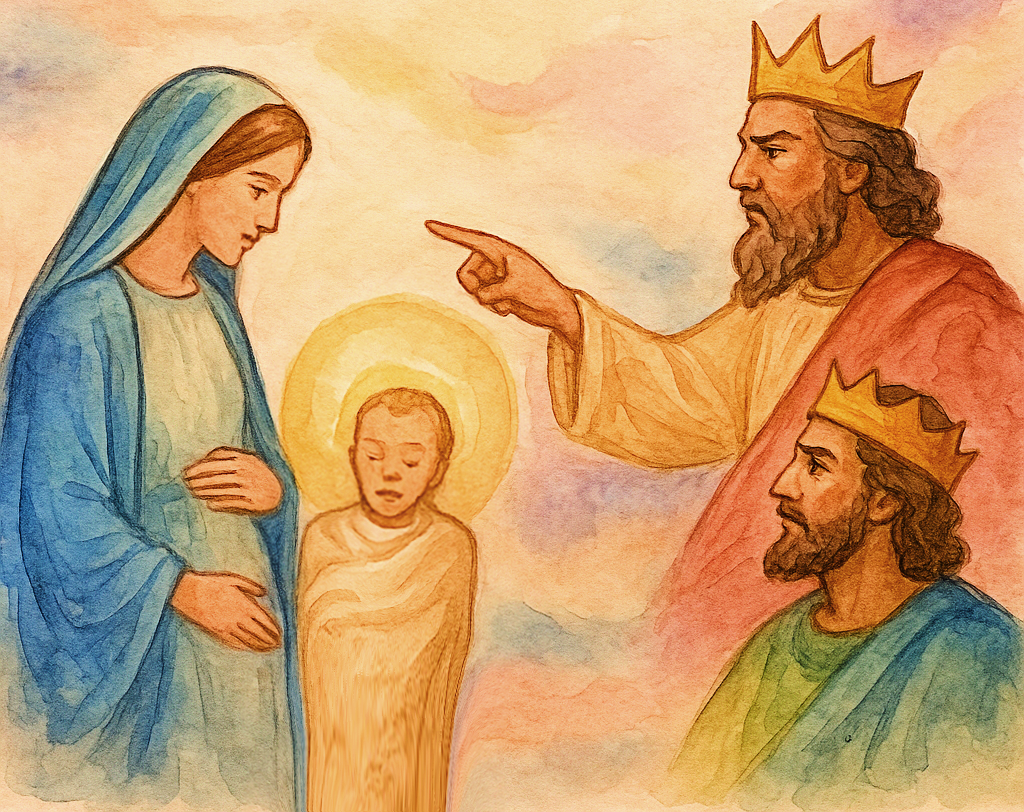
Explore the deeper meaning of Isaiah 7:14 and Psalm 2 in the context of the Law and the covenant. Does the prophecy of the virgin conception exclude the male role? How do ancient scriptures reconcile divine calling, marriage, and kingship?
Introduction
Isaiah 7:14 states:
“Behold, the virgin shall conceive and bear a son, and shall call his name Immanuel.”
This verse is often treated as a straightforward prophecy of Jesus' birth. But does it truly foretell a miraculous conception through the Holy Spirit, or have layers of interpretation blurred its meaning?
This article explores the theological, legal, and symbolic depth behind Isaiah’s words and their connection to Psalm 2, a central messianic psalm.
Isaiah 7:14 Contextual Prophecy or Supernatural Event?
Virgin means "young woman" or maiden, not necessarily a virgin by our modern definitions. In the context of Isaiah, it likely referred to a real woman in King Ahaz’s time, whose child would serve as a sign of Judah’s survival.
Later, Christian theology reinterprets this to refer to the Virgin Mary and Jesus. However, this reinterpretation introduces a non-explicit concept, the miraculous conception through the Holy Spirit, which is not found in Isaiah’s original prophecy.
Psalm 2: God’s Son and Messianic Authority
Psalm 2 complements Isaiah’s prophecy by presenting a divine declaration of kingship:
“The Lord said to me, ‘You are my Son; today I have begotten you.’”
Here, “Son” symbolizes a chosen king, not a supernaturally born individual. This reflects a royal installation of a king "begotten" by divine decree, not biology.
Continues:
“Ask of Me, and I will give You the nations as Your inheritance.”
The “Son” is the ruler of nations, a figure of divine authority, power, and covenant, not merely a newborn child of mystical origin.
Law: A Virgin Wife for the High Priest
Leviticus 21:13-14 states:
“He shall take a wife in her virginity… only a virgin of his people shall he take as his wife.”
This reveals the sacredness of union, not just the woman's virginity. The High Priest was required to marry a virgin, not because she was holy in her own right, but because the union was covenantal and pure.
This contradicts the notion that the absence of a man enhances sanctity. God’s law supports both male and female roles in fulfilling divine purposes.
The Danger of Ideological Extremes: Female Holiness vs. Male Guilt
Pagan traditions often elevated goddesses (Ishtar, Artemis, Cybele) as divine vessels while viewing male sexuality as impure. Some early Christian Gnostic sects adopted this view, exalting virginity and demonizing male participation in reproduction.
But this contradicts:
Psalm 2, where God’s “Son” rules with authority
Law, where male priesthood and covenantal union are sacred
Balance, where male and female together reflect the image of God (Genesis 1:27)
The Scriptures never elevate one sex over the other. They highlight divine partnership, not exclusion.
A Multi-Layered Prophecy
Isaiah 7:14 isn't just a supernatural teaser. It's a national sign, a guarantee that God is with His people. The virgin or young woman signifies faithfulness, while the child born (Immanuel) symbolizes hope and continuity.
Psalm 2 expands this vision with divine kingship:
“You are my Son,” a ruler, not merely an infant.
“Today I have begotten you,” a commission, not just a birth event.
The full prophetic meaning becomes clear when we see:
A faithful virgin (symbol of Israel or covenant purity)
A legitimate union (as prescribed by the Law)
A chosen Son (prophet, king, or messiah)
The enduring presence of God (Immanuel = “God with us”)
Conclusion: Divine Cooperation, Not Sex Exclusion
Isaiah 7:14, when seen alongside Psalm 2 and Leviticus 21, reveals a balanced theology:
Virginity is sacred, but so is holy union.
God calls both men and women into covenant.
The Messiah is not merely miraculously conceived, but divinely appointed.
When we strip away ideological misinterpretations, the Scriptures show us a deeper truth:
Sanctity is not about bypassing human nature but about fulfilling it within God’s order.
Man and woman together reflect the covenant and the Kingdom.
Moder
Introduction
The Holy Book consistently emphasizes the enduring power of God’s Word. One of the most profound declarations of this truth is found in Isaiah 55:11:
“So shall My word be that goes forth from My mouth;
It shall not return to Me void,
But it shall accomplish what I please,
And it shall prosper in the thing for which I sent it.”
(Isaiah 55:11, NKJV)
But how consistently has this promise been preserved across ancient manuscripts? In this article, we explore Isaiah 55:11 by comparing three key textual witnesses:
The Hebrew Masoretic Text (MT),
The Greek Septuagint (LXX),
And the Dead Sea Scrolls (specifically the Isaiah Scroll, 1QIsaᵃ).
Together, these sources reveal the extraordinary preservation of God’s Word through the centuries.
Isaiah 55:11 in the Hebrew Masoretic Text
The Masoretic Text (MT) is the standard Hebrew version of the Old Testament, faithfully preserved by Jewish scribes. Isaiah 55:11 in the MT reads:
“So shall My word be that goes forth from My mouth;
It shall not return to Me empty,
But it shall accomplish what I desire,
And succeed in the purpose for which I sent it.”
Key Points:
God’s Word is purposeful and effective.
It never returns empty, but always fulfills His will.
This version has been foundational for most modern Holy Book translations and reflects the text used by Jewish communities for centuries.
Isaiah 55:11 in the Greek Septuagint (LXX)
The Septuagint (LXX), an ancient Greek translation of the Hebrew Scriptures (3rd–2nd century BC), provides further insight with powerful Greek phrasing. The LXX renders Isaiah 55:11 as:
“So shall my word be, which goes forth from my mouth;
It shall never return to me empty,
Until it accomplishes what I willed,
And prospers in the things for which I sent it.”
What Stands Out?
The Greek employs a strong double negative, οὐ μὴ (ou mē), meaning “never, by no means.”
This emphasizes the absolute certainty that God’s Word cannot fail to accomplish its purpose.
Isaiah 55:11 in the Dead Sea Scrolls (1QIsaᵃ)
The Dead Sea Scrolls, discovered between 1947 and 1956, include a nearly complete copy of Isaiah (1QIsaᵃ) dated to the 2nd century BC. Isaiah 55:11 in this scroll reads almost identically to the Masoretic Text:
“Thus shall My word be that goes out of My mouth;
It shall not return to Me empty,
But it shall accomplish what I desire,
And succeed in the purpose for which I sent it.”
One remarkable fact is that the Isaiah Scroll found among the Dead Sea Scrolls (1QIsaᵃ) is over 1,000 years older than the Masoretic Text manuscripts we had before its discovery. Despite this vast time gap, the wording of Isaiah 55:11 remains virtually identical, demonstrating the extraordinary preservation of God’s Word across the centuries.
Key Observations:
Virtually no textual differences regarding Isaiah 55:11.
Minor spelling variations do not affect meaning.
Confirms that God’s Word has been faithfully preserved for more than two millennia.
Why This Matters
The consistency of Isaiah 55:11 across the Hebrew Masoretic Text, the Greek Septuagint, and the Dead Sea Scrolls confirms an essential truth:
God’s Word is unchanging, trustworthy, and eternally effective.
Despite spanning languages, cultures, and thousands of years, God’s promise remains the same: His Word will never return void and will always fulfill its divine purpose.
The Unbreakable Word of God
The Septuagint’s powerful phrasing (“never at all return empty”) deepens our understanding of God’s unwavering faithfulness. This truth is echoed throughout Scripture:
“Lift up your eyes to the heavens,
And look on the earth beneath.
For the heavens will vanish away like smoke,
The earth will grow old like a garment,
And those who dwell in it will die in like manner;
But My salvation will be forever,
And My righteousness will not be abolished.”
(Isaiah 51:6, NKJV)
“Heaven and earth will pass away, but My words will by no means pass away.”
(Matthew 24:35, NKJV)
These verses remind us that while heaven and earth are temporary, God’s Word endures forever. It remains alive, powerful, and unshaken throughout all generations. Although the New Testament presents a simplified and stylized version of the Old Testament.
Final Thoughts
This remarkable preservation of Isaiah 55:11 from ancient times until today demonstrates that God’s Word was not only given to humanity but was also protected by His power across millennia.
God’s Word is alive. It is eternal. It succeeds wherever it is sent.
In a world of shifting ideas and fleeting promises, His Word stands unchanging, calling us to believe, to trust, and to live by every word that proceeds from His mouth.
Tag Search

Ads
SubMeet


Ads

Rose

