
SubMeet Blog Posts
Write your:
Biography, story, article or tidings.
Maximum 50.000  symbols (Depends on the browser) one post.
Maximum 10 posts per day, 100 posts per month, for one user.
We recommend using the Firefox browser to publish a post.



 Marshal
Tigranes the Great: King of Kings
Tigranes II, also known as Tigranes the Great, was the most powerful Armenian king in history. Under his leadership, Armenia expanded into a regional superpower, earning him the title "King of Kings" from his contemporaries.
The Extent of His Empire
According to ancient historians such as Strabo and Plutarch, Tigranes created an empire that stretched:
- West to the Mediterranean Sea
- North to the Caucasus Mountains
- East near the Caspian Sea
- South deep into Syria and parts of Mesopotamia
At its peak, his empire bordered the Roman Republic and the Parthian Empire, controlling vast swaths of the Near East.
Did Tigranes Conquer Jerusalem?
The short answer is no — Tigranes the Great did not conquer Jerusalem. However, he did come dangerously close to it.
According to Josephus, the 1st-century Jewish historian, Tigranes invaded Syria around 83 BCE and laid siege to Antioch, the capital of the Seleucid Empire. His growing power alarmed neighboring regions, including Judea, the Jewish kingdom governed at that time by Alexander Jannaeus.
Fearing an Armenian invasion, the Jews reportedly sent emissaries and gifts to Tigranes to avoid conflict. Josephus does not describe a military campaign in Jerusalem itself, but the threat was very real.
"Tigranes, King of Armenia, came down and took Syria, and made it tributary to him."
— Josephus, Antiquities of the Jews, Book 13
This indirect reference confirms that Tigranes had significant political influence in the region, though not a physical conquest of Jerusalem.
Clarifying the Size of His Army
Josephus also mentions that Tigranes had an army of 500,000 soldiers. While this number is frequently cited, modern historians generally consider such figures to be exaggerated. Realistically, his army may have numbered 100,000 to 200,000, still a formidable force for the era.
Language and Writing During Tigranes’ Reign
Although the Armenian alphabet had not yet been invented (it would come about in the early 5th century CE by Mesrop Mashtots), the people of Tigranes’ empire communicated through several languages:
- Greek: The administrative and cultural elite often used Greek, especially for coins and official inscriptions.
- Aramaic: Widely spoken in daily life and used for commerce and local governance.
- Persian dialects: Also present in eastern parts of the empire due to interactions with the Parthians and Medes.
Armenian (proto-Armenian) was spoken among the people, but the Armenian alphabet had not yet been created.
Tigranes established the new royal capital, Tigranocerta, which became a multicultural metropolis showcasing Hellenistic architecture and Greco-Armenian administration.
The Historical Importance of Tigranes
Tigranes’ ambition and military campaigns reshaped the Near East. He stood as one of the few regional leaders capable of defying Roman and Parthian influence simultaneously.
Even though he never set foot in Jerusalem, his regional dominance brought Armenia to the forefront of ancient geopolitics. His diplomacy, conquests, and administrative reforms laid the groundwork for centuries of Armenian cultural and political identity.
Conclusion: Tigranes and Jerusalem — A Near Encounter
Classical sources confirm his invasion of Syria and the concern his military might caused among the Jewish rulers. His reign marks the zenith of Armenian influence in the ancient world.
MarshalIn this article, we explore Armenian's classification, compare it with Greek and Hebrew, and analyze its alphabet, vocabulary, grammar, and historical significance.
Is Armenian Its Own Language Family?
Although Armenian belongs to the Indo-European family, it does not have any direct sister languages within the group. Instead, it constitutes a single-language branch, similar to Greek and Albanian, making it distinct from the larger Indo-European subgroups.
Key Facts About Armenian:
An independent branch within Indo-European, like Greek and Albanian.
A literary tradition dating back to the 5th century AD.
A unique alphabet created by Mesrop Mashtots in 405 AD.
Influences from Persian, Greek, and Semitic languages due to historical interactions.
Comparison: Armenian vs. Greek vs. Hebrew
Greek and Hebrew belong to different language families. Greek is Indo-European, while Hebrew is Semitic. Despite this, historical and cultural exchanges have led to linguistic influences and similarities in structure, phonetics, and vocabulary.
Armenian vs. Greek
Alphabet and Writing System
The Armenian alphabet was influenced by Greek but was uniquely designed by Mesrop Mashtots, incorporating elements from Greek, Pahlavi (Middle Persian), and possibly Syriac scripts.
Both Armenian and Greek use phonetic alphabets, meaning words are generally written as they are pronounced.
Grammar and Structure
Armenian retains a complex case system, comparable to Ancient Greek, whereas modern Greek has simplified its case system over time.
Greek employs articles, while Armenian expresses definiteness through suffixes.
Phonetics and Pronunciation
Armenian features more consonant clusters, making its pronunciation more complex.
Both languages emphasize syllabic stress, though Greek has a more melodic intonation.
Armenian vs. Hebrew
Alphabet and Writing System
Hebrew uses an abjad, often omitting vowels in writing, whereas Armenian has a fully phonetic script, making pronunciation more predictable.
Grammar and Structure
Armenian follows a Subject-Object-Verb (SOV) word order, whereas Hebrew has a flexible structure (VSO/SVO).
Armenian verbs conjugate similarly to other Indo-European languages, while Hebrew verbs are based on root patterns and binyanim (verb forms).
Phonetics and Pronunciation
Hebrew features guttural sounds (e.g., ח, ע), which are less prominent in Armenian.
Armenian preserves vowel harmony, a characteristic absent in Hebrew.
Vocabulary & Lexical Influence
Armenian has absorbed vocabulary from Greek, Persian, and Arabic due to cultural exchanges. While some Armenian and Greek words share common Indo-European roots, these are not loanwords but inherited terms from their Proto-Indo-European ancestry.
Religious and cultural interactions have contributed some Hebrew terms to Armenian, but the influence is more theological than linguistic. Greek and Syriac had a more significant impact on Armenian Christian terminology than Hebrew.
Epic Traditions: Armenian, Greek, and Hebrew Literature
Each of these languages carries an ancient literary tradition that reflects their civilizations’ values and histories.
Armenian Epic: "The Daredevils of Sassoun" (Սասնա Ծռեր)
Armenian: «Մայր իմ, ինչու ես վախենում, ես չեմ մեռնի, ես անմահ եմ».
English: "Mother, why do you fear? I will not die; I am immortal."
Greek Epic: "The Iliad" (Ἰλιάς)
Greek: «Μῆνιν ἄειδε, θεὰ, Πηληϊάδεω Ἀχιλῆος».
English: "Sing, O goddess, the wrath of Achilles, son of Peleus."
Hebrew Epic Tradition
It can be argued that it does not have a singular epic in the same way that Greek or Armenian cultures do, such as the Iliad or The Daredevils of Sassoun. Instead, evolved through sacred texts and rabbinic discourse rather than through a unified heroic epic.
Final Thoughts: Why Armenian Stands Apart
Despite its Indo-European roots, Armenian remains a distinct linguistic entity. Unlike Greek, which has retained its influence in philosophy and science, and Hebrew, which was revived as a modern spoken language, Armenian continues to thrive as a bridge between the ancient and modern worlds. Through its unique alphabet, rich literary heritage, and linguistic evolution, Armenian remains an invaluable link to human history and cultural continuity.
 Moder
Moder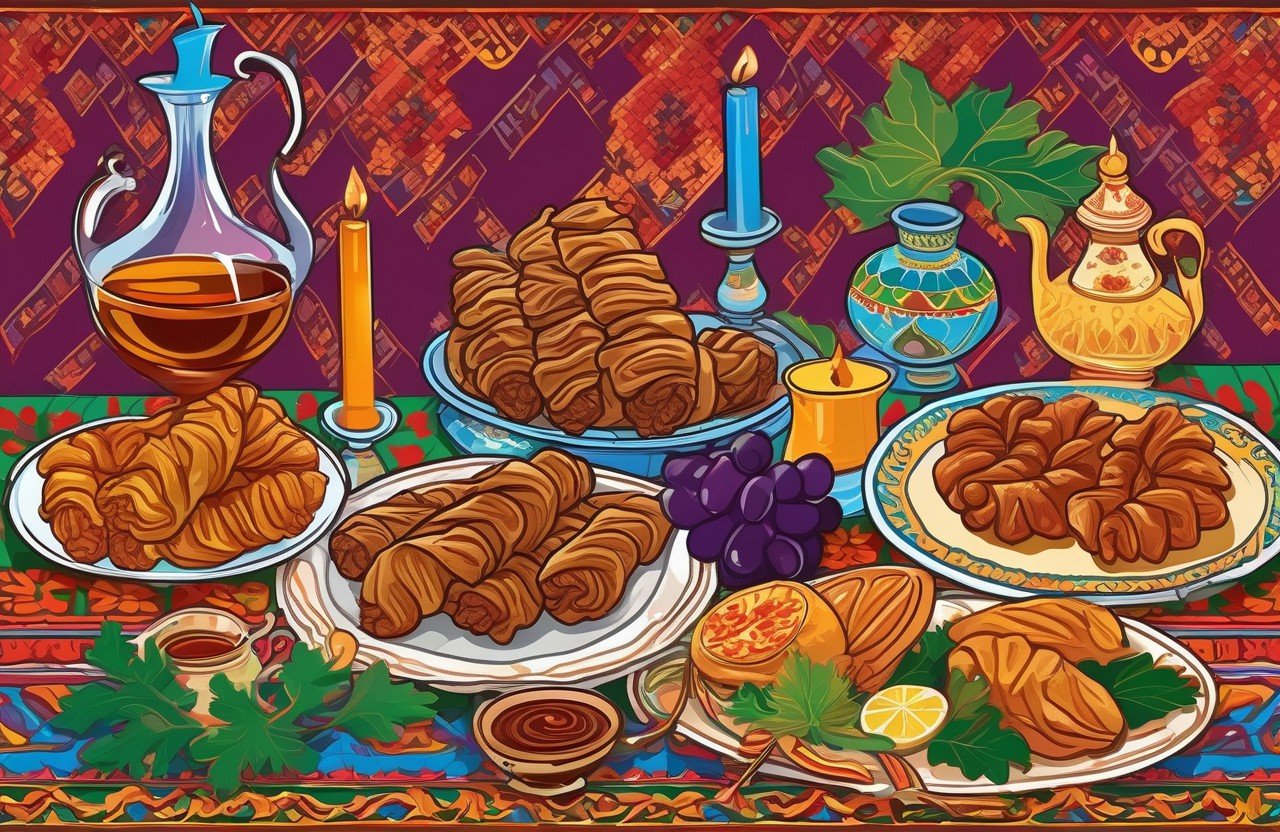
The New Year is a time of joy and togetherness, and the festive table plays a central role in bringing loved ones together. In Armenia, the New Year’s table is more than just a feast; it symbolizes abundance, tradition, and hospitality. Here’s how you can decorate your table with traditional Armenian dishes, pastries, fruits, and drinks while making it appealing to guests from any culture.
1. Traditional Armenian Dishes to Anchor the Table
The centerpiece of an Armenian New Year’s table is its savory dishes. These options not only please the palate but also add a touch of cultural heritage to the décor:
Tolma (Stuffed Cabbage or Grape Leaves): This traditional dish, served in ornate dishes, represents the warmth of family gatherings.
Khashlama is a hearty beef or lamb stew paired with root vegetables, served in clay pots for an authentic rustic look.
Grilled Kebabs (Khorovats): Perfectly grilled meats presented on skewers or platters add flair to the table.
2. Pastries for Sweetness and Charm
Armenian pastries bring sweetness and a festive aroma to the table.
Gata (Sweet Pastry Bread): A decorative gata loaf is delicious and often inscribed with intricate patterns that symbolize good luck.
Pakhlava (Baklava): Cut into diamond shapes and decorated with pistachios, pakhlava is a must-have.
Chorek (Sweet Bread): A braided bread sprinkled with sesame seeds or sugar completes the pastry selection.
3. Seasonal Fruits for Elegance and Symbolism
Fruits are a cornerstone of the Armenian New Year table, signifying health and prosperity.
Pomegranates: Known as the symbol of Armenia, pomegranates add a pop of red to the table while representing fertility and life.
Dried Fruits: Dried apricots, plums, and figs arranged in wooden trays offer natural sweetness.
Fresh Citrus Fruits: Oranges and tangerines bring brightness and energy, often arranged in decorative bowls.
4. Drinks to Toast the Occasion
Armenian Brandy: Known worldwide, a bottle of aged Armenian cognac is an elegant addition to the table.
Homemade Wine: Displayed in crystal decanters, it adds a personal touch.
Compote: A sweet fruit-based drink, typically made with apricots or cherries, offers a non-alcoholic option.
5. Table Decoration Ideas for All Cultures
Even if you’re not Armenian, these ideas can inspire your New Year’s celebration:
Use embroidered tablecloths or runners with traditional patterns.
Include candles or small lanterns for a warm glow.
Arrange evergreen branches or pinecones for a seasonal touch.
Place small gifts or handwritten notes on each guest’s plate to enhance the festive spirit.
Why SubMeet Inspires Connection During New Year’s Festivities
This Armenian-inspired guide reflects SubMeet’s mission to celebrate cultural connections and unite people. On SubMeet, you can share your New Year’s table photos, organize celebrations with friends, or find inspiration for your next cultural event.
Tag Search

Ads
SubMeet


Ads

Rose

