
SubMeet Blog Posts
Write your:
Biography, story, article or tidings.
Maximum 50.000  symbols (Depends on the browser) one post.
Maximum 10 posts per day, 100 posts per month, for one user.
We recommend using the Firefox browser to publish a post.



 Marshal
The Cryptocurrency Vulnerability
Cryptocurrencies like Bitcoin, Ethereum, and Solana rely on a decentralized network of computers, but that network depends on the internet to stay alive. Without connectivity, transactions cannot be confirmed, blocks cannot be added, and the blockchain freezes in time. Bitcoin would not “vanish” overnight; copies of the blockchain would remain on hard drives worldwide, but it would become unusable for an indefinite period. In financial terms, this would feel like billions of dollars instantly vanishing into thin air.
Beyond Crypto: The Collapse of Digital Communication
The effects would not stop with financial systems. A major internet blackout would also mean:
- Email blackouts
- Loss of online calls
- Websites vanish
The modern economy is entirely dependent on the internet. This dependence makes the global digital infrastructure and the systems built on it uniquely vulnerable if these underlying connections are lost.
Scenarios That Could Trigger a Global Internet Shutdown
World War III
A large-scale conflict could involve cyberattacks targeting undersea cables, satellites, and data centers. Even if not every country is directly attacked, the disruption of international internet “backbones” could fragment the web into isolated regions.
Revolutions and Violent Power Grabs
Authoritarian regimes have already demonstrated the ability to shut down the internet during unrest. If such a scenario occurred in a major power like the United States, the consequences would ripple worldwide. A sudden American internet blackout would cripple global finance, communication, and commerce overnight.
Cyberterrorism and Sabotage
Coordinated attacks on infrastructure, such as data centers, power grids, or satellites, could disable the internet in critical regions. Unlike wars, this could happen suddenly, without warning, and spread panic.
Natural Disasters on an Unprecedented Scale
Solar storms, massive earthquakes, or other natural events could physically damage the hardware of the internet, creating regional or even continental blackouts.
The Global Consequences
Collapse of confidence in digital assets: Bitcoin and cryptocurrencies could lose most of their market value within days.
Flight to physical assets: Gold, silver, land, and tangible goods would suddenly look far more reliable.
A Wake-Up Call
The scenario of a global internet shutdown may sound extreme, but it is not science fiction. Governments already practice internet blackouts in times of unrest. Undersea cables have been cut accidentally, and sometimes deliberately. Military strategists openly discuss the internet as a battlefield.
Bitcoin and blockchain technology were designed to survive censorship, but not to survive a world without connectivity. The same vulnerability applies to online communication, cloud-based services, and even the way businesses and families stay connected.
The core issue is not just financial loss; it is whether our digital civilization can survive if the foundation, the internet, disappears. Without connectivity, the promise of decentralization, digital communication, and even basic services comes into question. This vulnerability exposes the risks at the heart of the digital world.
MarshalBitcoin (BTC)
Forecast: Analysts predict Bitcoin could reach six figures by 2025, with some estimates ranging from $100,000 to $120,000. The halving event in April 2024 is expected to drive scarcity, historically triggering price surges in subsequent years.
Layer: Bitcoin operates on Layer 1 as a standalone blockchain.
Impact of Layer: Bitcoin's simplicity as a payment network and store of value has maintained its dominance. Its secure Layer 1 infrastructure contributes to its stability and appeal as "digital gold."
Ethereum (ETH)
Forecast: Ethereum is expected to trade between $4,000 and $6,000, with the transition to Proof of Stake through Ethereum 2.0 fueling growth.
Layer: Ethereum is a Layer 1 blockchain supporting smart contracts and decentralized applications.
Impact of Layer: Ethereum’s scalability upgrades, such as sharding and Layer 2 rollups like Arbitrum, will likely enhance its efficiency and adoption, boosting its price trajectory.
Solana (SOL)
Forecast: Solana could rise to $250–$300 by 2025, driven by its high transaction speed and low fees.
Layer: Layer 1 blockchain.
Impact of Layer: Solana’s fast and scalable Layer 1 structure makes it ideal for DeFi and NFT ecosystems. However, occasional outages may introduce risks.
Popular Altcoins
Cardano (ADA)
Forecast: $0.95–$1.50. Known for its academic rigor, Cardano’s continued development of Layer 1 solutions makes it a competitor in decentralized finance (DeFi).
Layer: Layer 1 blockchain.
Polkadot (DOT)
Forecast: $7–$12. Polkadot’s parachain architecture enables interoperability among blockchains.
Layer: Layer 0 (meta-layer).
Avalanche (AVAX)
Forecast: $40–$50. It competes with Ethereum via its subnets feature for app-specific blockchains.
Layer: Layer 1.
Chainlink (LINK)
Forecast: $18–$25. Chainlink’s role as a decentralized oracle provider strengthens its value in DeFi.
Layer: Layer 2 (built on Ethereum).
Cosmos (ATOM)
Forecast: $10–$20. Known Cosmos, also known as the "Internet of Blockchains," Cosmosts interoperability.
Layer: Layer 0 (meta-layer).
Popular Meme Coins
Dogecoin (DOGE)
Forecast: $0.60–$0.95. While less functional, its community-driven nature keeps it relevant.
Layer: Layer 1.
Shiba Inu (SHIB)
Forecast: $0.00003–$0.00004. Shiba’s ecosystem growth, including Shibarium (Layer 2), is a key factor.
Layer: Layer 2 (on Ethereum).
Pepe (PEPE)
Forecast: Highly speculative, prices depend on community hype.
Layer: Layer 2 (on Ethereum).
Understanding Blockchain Layers: Decoding Cryptocurrency Infrastructure and Price Influences
To determine the layer on which a cryptocurrency operates, it is essential to understand the blockchain structure and how the coin's protocols interact with it. The layers of a blockchain ecosystem are categorized based on their functionality and design.
Layers Explained:
Layer 0: The foundational network infrastructure, often comprising protocols like the Internet or frameworks like Polkadot and Cosmos, which enable interoperability among multiple blockchains.
Layer 1: The main blockchain handles consensus mechanisms, token issuance, and transaction validation. Examples include Bitcoin, Ethereum, and Solana.
Layer 2: Protocols built on top of Layer 1 to enhance scalability and efficiency. Examples include Lightning Network for Bitcoin and Optimism for Ethereum.
Layer 3: Application-specific layers, like dApps or user-facing interfaces, utilizing Layer 1 and Layer 2 features for various purposes.
How to Determine a Cryptocurrency’s Layer:
Technical Documentation: Reviewing whitepapers and developer guides clarifies the blockchain architecture and the layer classification.
Official Announcements: Developer or official blockchain websites often confirm the layer and technological underpinnings.
Use Cases: The coin's purpose (e.g., transaction scalability or dApp development) often indicates its layer.
Does the Layer Matter for Price?
The blockchain layer greatly affects price performance. Coins on Layer 1, like Bitcoin and Ethereum, benefit from security and decentralization. Layer 2 solutions improve scalability and reduce transaction costs, boosting user adoption and market confidence. Layer 0 meta-layers, like Polkadot and Cosmos, create ecosystems that attract diverse projects, potentially increasing value.
Conclusion
As cryptocurrencies evolve, understanding their blockchain layers, utilities, and market cycles is essential for traders. While Bitcoin and Ethereum remain dominant, altcoins like Solana and Polkadot, and even meme coins like Shiba Inu, have opportunities for growth driven by technological and market trends. However, volatility persists, so thorough research and risk management are critical.
 Marshal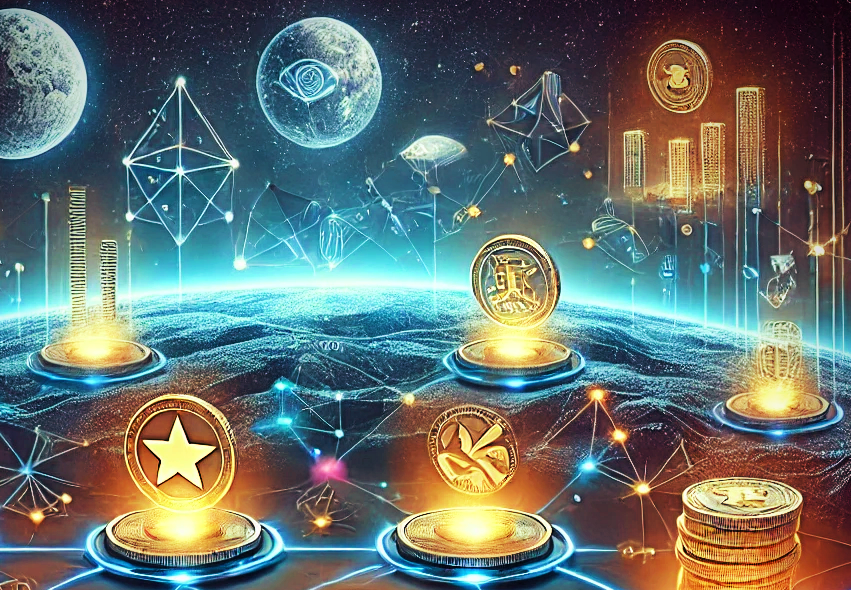
As the cryptocurrency world continues to expand, projects focusing on seamless integration and cross-chain capabilities have gained significant traction. Among the newest tokens, deBridge (DBR) has emerged as a key player in the decentralized finance (DeFi) and interoperability space. Created in August 2021, deBridge allows for efficient, decentralized transfers of assets and data between multiple blockchains, addressing a critical need in the increasingly fragmented crypto landscape.
In this article, we’ll explore deBridge (DBR) alongside similar new tokens that were launched after 2020, each striving to redefine the blockchain ecosystem.
deBridge (DBR): Cross-Chain Messaging Powerhouse
Launched in August 2021, deBridge facilitates cross-chain messaging, decentralized governance, and seamless asset transfers. Validators in the deBridge network ensure transaction security, creating a resilient, decentralized platform for blockchain integration. The DBR token plays a key role in governance, incentivizing validators, and supporting ecosystem development.
With cross-chain projects becoming increasingly vital, deBridge offers a robust infrastructure for developers and users looking to leverage the power of multiple blockchains without central intermediaries.
Stargate Finance (STG)
Stargate Finance (STG), launched in 2022, is another cross-chain liquidity protocol that allows users to transfer assets across blockchains without needing centralized exchanges. Stargate is a part of the LayerZero ecosystem and works by enabling the movement of native assets through its unified liquidity pool. This solution is particularly attractive to decentralized finance (DeFi) users seeking to transfer liquidity efficiently across various blockchain networks.
The STG token is used for governance within the protocol, giving holders a say in future developments and adjustments, similar to deBridge’s DBR.
Synapse (SYN)
Synapse (SYN), introduced in late 2021, has rapidly grown as a cross-chain protocol offering fast, secure bridges between different blockchains. Synapse is designed to handle cross-chain swaps, asset transfers, and even smart contract interactions between supported chains.
The SYN token is essential for paying transaction fees on the network and securing governance over the protocol’s future. Synapse’s focus on scalability and security makes it a strong competitor in the cross-chain interoperability space.
Moonbeam (GLMR)
Moonbeam (GLMR), launched in January 2022, is an Ethereum-compatible parachain on Polkadot, enabling developers to deploy existing Ethereum dApps with minimal changes. Moonbeam simplifies cross-chain integrations and facilitates seamless smart contract deployment between Ethereum and Polkadot, leveraging Polkadot’s high-speed, secure infrastructure.
The GLMR token serves as the utility token for staking, governance, and transaction fees within the Moonbeam network. Like DBR, it’s a key part of Moonbeam’s cross-chain vision.
Router Protocol (ROUTE)
Router Protocol (ROUTE), also launched in 2021, provides a bridging infrastructure aimed at enabling interoperability across Layer 1 and Layer 2 blockchains. The router’s system supports asset transfers, swaps, and even dApp functionality across different ecosystems. It positions itself as a "universal connector" between blockchains, leveraging cross-chain liquidity aggregation.
The ROUTE token is integral to governance, incentivizing network validators and users. It plays a similar role to DBR, contributing to a decentralized future for blockchain networks.
Multichain (MULTI)
Multichain (MULTI), launched in early 2022, has quickly become one of the most comprehensive cross-chain platforms available, supporting the transfer of assets, smart contracts, and data across over 42 blockchains. Multichain (formerly AnySwap) is especially popular among decentralized exchanges (DEXs) and DeFi platforms looking to expand their multi-chain capabilities.
The MULTI token serves as the utility and governance token for the platform, giving users the ability to stake and participate in governance while enabling cross-chain transfers.
Conclusion: The Cross-Chain Revolution is Here
Since 2020, the blockchain world has seen a surge of innovation in cross-chain protocols, each introducing novel ways to enhance blockchain interoperability and ecosystem growth. Projects like deBridge (DBR), Stargate Finance (STG), Synapse (SYN), and others are paving the way for a more connected and decentralized future.
As the demand for cross-chain solutions grows, these tokens represent more than just technical innovations-they provide users and developers with the tools necessary to navigate a multi-chain world with efficiency, security, and decentralization.
These tokens are shaping the future of decentralized finance, and keeping an eye on their development could offer valuable insights into the next major wave in cryptocurrency innovation.
 Moder
Moder
Are you looking for ways to supplement your income online? Check out these nine websites offering various earning possibilities, from skill development to microtasks.
Learn and Earn: Blockchain Education
bitdegree.org: Expand your knowledge in blockchain, crypto, and web development with their courses and learning paths. While the primary focus is education, they sometimes offer scholarships and paid opportunities for skilled individuals. This is best for those who want to build a career in the Web3 space.
Web3 Bounties and Tasks
soquest.xyz: Earn rewards by completing promotional quests for Web3 projects. These can involve social media tasks, testing new games, or providing feedback.
taskon.xyz: Similar to soquest.xyz, this platform lets you tackle microtasks within the Web3 world to earn cryptocurrency rewards.
layer3.xyz: Discover various bounties offered by Web3 projects. These bounties might involve larger tasks with more substantial rewards, appealing to those with some experience in the field.
Microtask Platforms
jumptask.io: Complete surveys, engage on social media, or perform data entry and get paid in JumpTask's (JMPT) cryptocurrency. This platform is good for those who want to earn small amounts in their spare time.
Crypto and Web3 Analytics
dappradar.com: Monitor and analyze decentralized applications (dApps) across blockchains. While not a direct earning platform, it's an invaluable tool for those who want to invest in dApps or potentially contribute to projects with high earning potential.
cryptorank.io: Track cryptocurrency performance, rankings, and data. Like dappradar.com, this is primarily for research purposes but can help you identify potentially lucrative crypto investments.
Web3 Credentials and Learning
galxe.com: Participate in learning campaigns and complete quizzes to earn NFTs on Galxe. These NFTs act as credentials, showcasing your knowledge or participation in projects. While they may not directly offer income, the NFTs could gain value or open future earning opportunities.
Passive Income (Limited Potential)
honeygain.com: Share unused internet bandwidth through the Honeygain app. Keep in mind that earnings tend to be very small for most users and depend on your location and internet usage.
Important Considerations:
Earnings vary wildly: Income potential differs greatly between platforms and often depends on your skills, time invested, and market conditions.
Research is key: Before committing to a platform, research its reputation, payment methods, and the potential rewards.
Microtasks vs. skill development: Microtask platforms offer small, quick payments, while platforms like bitdegree.org focus on long-term skill acquisition with better future income potential.
In conclusion, the world of online earning opportunities is incredibly diverse. Whether you're keen on upskilling in the Web3 sector, tackling microtasks for quick rewards, or strategically analyzing the crypto market, there's a website tailored to your needs. Be sure to choose a platform that aligns with your skills, time commitment, and desired income level.
Tag Search

Ads
SubMeet


Ads

Rose

