SIGN*IN

On the Path of Truth (Novel) from Vinci's blog
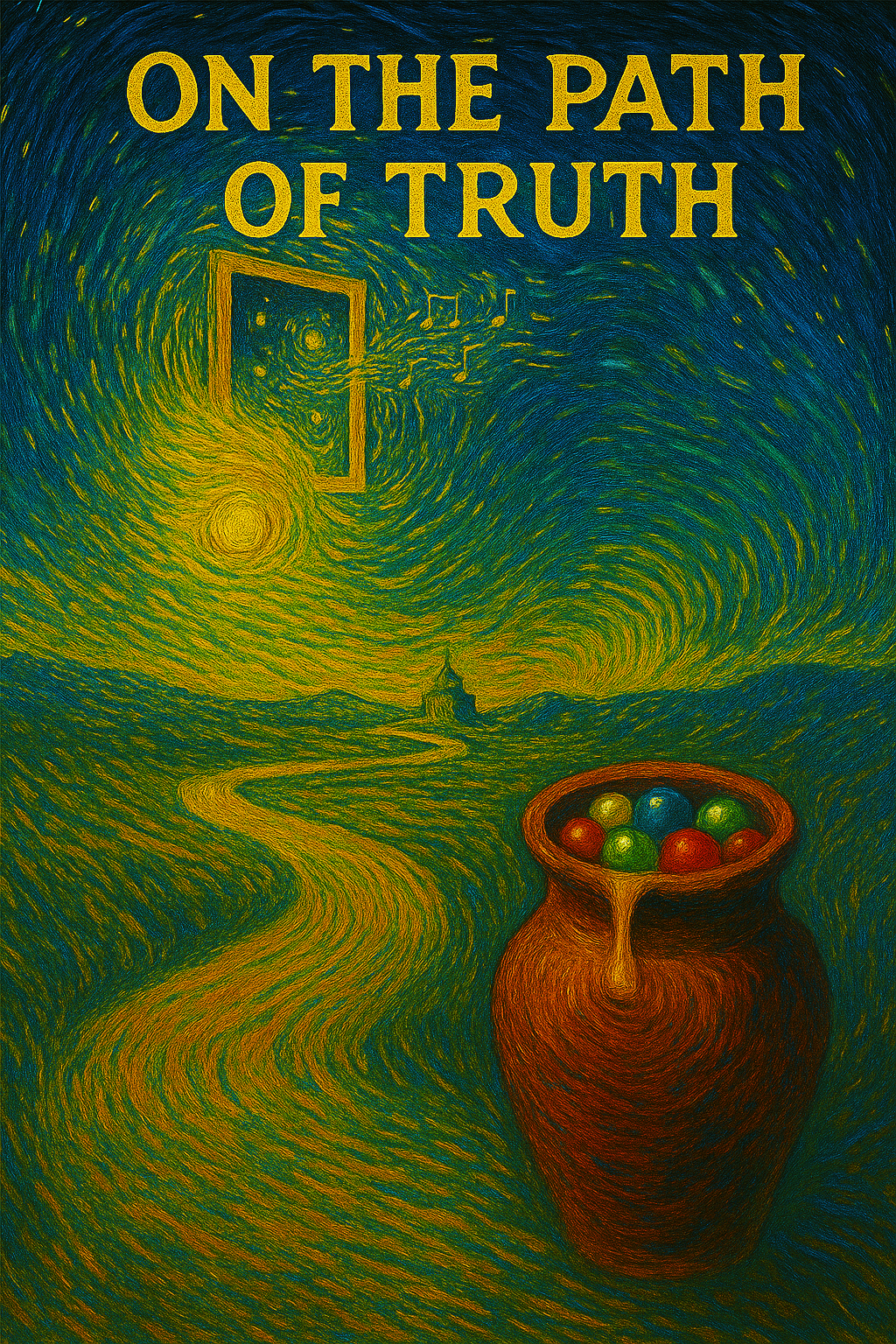
In the futuristic dawn of 2086, Isaac’s chance encounter with a divine figure on a quiet street ignites a transformative journey. Written between 2013 and 2014, the novel On the Path of Truth (originally in Armenian) interweaves prophetic revelations and fantastical twists into a narrative of spiritual discovery, mystical events, and a journey to Peru that unveils hidden truths. Dare to explore a world where faith confronts the unknown.
On the Path of Truth
At the corner of the street stood a girl dressed in tattered rags. She wore old rags, and we were strolling down the breadth of the street, joyful and lively, with words and laughter, as if intoxicated—not by wine. It was a brownish morning, and the road appeared milky. The girl, or perhaps woman, in old rags gazed directly into my eyes. At that very moment, my friend beside me said, “Look at that Old Rags now; she’s staring straight into my eyes.” One of the girls walking with us also remarked, “Kids, this Old Rags is looking straight into my eyes. Could she be one of those?” and a burst of laughter swept through us all. (In truth, that woman could look into all our eyes simultaneously; indeed, she was God, and none of us, neither one nor the other, realized it.) I also said, “Now let me go see who that girl in Old Rags is, as if she’s looking straight at me,” and I quickly reached the spot (it felt as though I arrived swiftly because God hastened time and my steps) and said, “Hey, girl, you seem like my father—you’re looking straight into my eyes like a father.”
Then I heard a man’s voice—not a woman’s—hoarse yet soft and even pleasant. He said, “Greetings, my Son, I am the Lord, God. I have come to save you.” The old rags God wore were black, but they appeared new, not worn out, meticulously pieced together, and they emitted a fragrance so pleasant from the woman that it opened my breath and uplifted my mood. The woman also had a face that seemed fitting only for God—beautiful up close and stunning from afar. Her skin was a blend of white, gold, and green; her hair was pomegranate red, and she exuded an inexplicable, palpable aura—God. Because of her beauty, it was as if God’s features resembled a woman’s—smiling and giggly—while her body reminded me of a man’s. Her posture revealed that her strength was intact—more than that, how can one even measure God’s strength? Behind her hung a transparent door in the air, half-open, leading to an infinity filled with star clusters. From that infinity, wonderful music resounded—just for me.
I felt that salvation had already occurred. Yet, I also sensed with horror that something else still needed to happen—to me, to those with me, and to those who were not with me—as if hell roared beneath my feet and called out to me. God said to me, “When you are afraid, I will send you joy and comfort.” I asked God, “What if I grow bored? I know boredom is worse than fear.” God replied, “When you grow bored, know that you are on the cross, without nails, without wood, crucified. The cross is the sign of boredom, and know that people have deliberately bored and crucified you.” Again, God spoke and said, “Return to your friends. I will ascend to Heaven, to My invisible throne. When you arrive home, you will find a glass of milk with honey on the table. You will drink it, and for nine months, no one will be able to bore you. You will simply open your mouth and laugh ha-ha at them. Your name will also be Laughter. After nine months, they will have one day to bore you. After that, the Holy Book will descend like a hammer on their heads, on the heads of those who bored you, and will pierce their heads. It will also descend on your head but will not pierce it. Just as they say that the head of the one who does good is pierced, so too must the head of the one who does evil be pierced.” God said, “There is money in your pocket. Give it all to me, and you will find it on the same table where the milk will be. Tell your friends that a beggar asked for money. Go now, and until you leave, I will remain here.” And so I did. We left, and I later reached home.
That day was summer. The day itself felt like summer; it happens. Let’s say the month is summer, yet the day feels like winter, or the month is winter—cold—yet the day feels like summer, or it is night but feels like day. It is day but feels like darkness. You can be full yet feel as if you are hungry, like a beast descending from the mountain without bread or water. It happens that you are hungry yet feel as if you are full. You are silent, yet everyone is clapping for you. You speak, but it turns out you have mumbled. That day was also summer. The month was also summer, and I was near the house door. The door was locked with a key. I reached into my pocket and realized the key was not there. In my mind, I said, “Either I lost it, or I gave it to God with the money.” Again, in my mind, I said, “Well, even better. My house and my money are safe in Heaven.” I noticed that the window of my house was slightly ajar. I entered through the window and saw that on the table were placed a glass of milk, money, and keys. It was the first time I felt these words of Scripture on my skin: “Then their pagan hearts shall be ashamed, and they shall feel the weight of their committed sins”—as if a stone idol sat on my shoulders, heavy. My emotions enveloped me like a storm, ready to solidify into a force capable of shaking the continents to their core. I, who was like a king, was walking and did not stop until a lion appeared before me. I had become as if an orphan who, having grown up, had left the orphanage. With difficulty, I approached the table, drank the milk, and I recall the glass slipping from my hand and crashing to the floor, and I remember falling face down on the floor.
From the knock on the door and Sarah’s voice, it seemed I came to my senses. The taste and sweetness of the honey were still in my mouth. Sarah was knocking on the door and calling, “Isaac, Isaac…” With difficulty, I opened my mouth and said, “Sarah, come in through the window. The door is locked. I feel unwell—why have you come at this late hour?” Shortly after, I sensed that Sarah was trying to help me rise from the floor and said, “Hey, boy, what late hour? It’s daytime. Where have you been these three days?” I realized that I had gone blind and had remained on the floor for three days. I wanted to conceal my blindness from Sarah, while she asked suspiciously, “Why are you looking for me with frozen eyes, and why did you say, ‘Why have you come at this late hour?’” I also remembered that there was some paper on the table with something written on it, but I had not read it before drinking the milk. I told Sarah, “There must be a paper on the table. Read it and see what is written. My eyes are stinging. I washed them with the wrong liquid, and they seem to have become inflamed.” Sarah read, “You will see after three days.” I understood that this was God’s paper. God also knew that I would not read the paper before drinking the milk. I told Sarah, “I called a doctor. He probably wrote that paper and left through the window as he had entered, while I was tending to my natural needs. The doctor will also send medicines for me. He said to just lie down and rest. As for where I was for three days—I will tell you later.” Sarah said, “Jesus Christ, what chaotic stories these are.” I also asked Sarah a sharp question, saying, “Sarah, allow me to jest: if Christ was not blind for at least a few days, then where did the blind Christians come from, and who has seen Christ’s face if not the sly fishermen, crawling tax collectors, and short-sighted scribes?” Sarah replied, “The liquid has had a good effect on you; you’ve turned from an architect into a prophet.”
If my blindness was not a trial, then it was a true revelation for me, especially since I knew it was temporary and expected, perhaps granting me new vision and eyes. I felt as if I were in a dance hall, a summoned and awaited guest. I remembered everyone—my relatives, acquaintances, friends, even strangers—moment by moment. Sarah’s always longing, deer-like gaze seemed to be before my eyes, with her drooping lower lip bearing a small dimple and green eyes, as if they were peaceful green lakes. Yet, when she was a little jealous, that peaceful lake would turn into a stormy sea, and at that time, everyone feared her, though her emotions were directed at me. Sarah was a painter; she had twin brothers who were my friends, Gabriel and Michael. Gabriel was one hour older than Michael. I was one year younger than them, while Sarah was two years younger than me, twenty-five years old. Gabriel was a designer, while Michael was a priest. Sarah painted icons on the walls inside the church. I always told her, “I love you, but I am repelled by your brush; you paint idols—they are right after all, that without thorns, there is no rose.” We always argued about this. I told her that the essence of an idol does not lie in its composition, whether it is stone, wood, or paint and picture, and I added, “God has chosen the golden mean so that people are a little idol-worshipping until the Red Sea splits, becomes two parts, and a path opens.” She replied that I was chasing fairy tales, and I told her, “Sarah, now man cannot truly believe in God because man is weak in faith but strong in caprice. All the religions of the world are caprices and profit, not faith.”
I answered Sarah, “Yes, Sarah, the liquid has had a profound effect on me, doubling my knowledge, as if it were the Holy Spirit and God’s milk, from which I went blind. But as they say, the blindness of the mind is worse than the blindness of the eye. If we are one body in love, then your green eyes will be mine, while my colorful mind will be yours.” Sarah said, “Hey, boy, maybe you are Christ. I am also painting you on the church walls, but without a ruler, though I love both of you.” I replied, “Sarah, Christ cannot be a self-serving man to be adored, but God’s mouth and word, and even that only from time to time, because Christ is a man; he dreams, sleeps, and wakes up; he can even see a delusion. God is higher than Christ, but man will not reach God until he understands Christ.” Sarah answered, “Isaac, it’s the 21st century now; your eyes will heal from the scum, as the doctor wrote that you will see in three days. So let my eyes remain mine, so that afterward, I will paint you large on the church walls with your black eyes, ha-ha. But seriously, I can’t wrap my head around your colorful mind now; maybe you’re right, unless Satan has deceived you.” I said, “Sarah, there is no Satan except sin and death. People have moved away from God and choose a king for themselves, while Satan feeds on the smell from the right and left, because the smell chooses only the best sheep. It happens that, confused, it chooses a goat as a king, which cannot protect the flock from the wolf, that is, from Satan. Meanwhile, the shepherd, the true king, is Christ, in whose time the wolf will simply evaporate like acetone.”
Sarah took my hand and said, “Come, I’ll accompany you to the living room so you can lie down on the couch, rest, and wait for the doctor’s medicines. And you’ll tell me where you were lost these three days. But until then, what will you say about God being a envy God? I’ve read about that in the Bible, in the Old Testament.” I replied, “It is written that God is also jealous, and that jealousy and envy are creative because God is a Creator. That envy is real and natural, filled with love, unlike the envy of a neighbor who has done no good and harbors only malice.” We reached the living room from the dining room on the left, passing through a zigzag corridor where there were three baklava-shaped bedrooms, while the bathroom and shower were on the second floor. The stairs were located between the two left bedrooms; the door of the right bedroom was directly opposite those stairs. The right intersecting walls of the corridor were cut by the bedroom door. The entrance to the living room was at the end of the corridor with its recessed stairs, rising about one meter. I had built the oval living room one meter higher than the corridor, while the dining room was one step lower than the corridor. The corridor began from the area adjacent to the dining room, where the house’s entrance door was. The dining room floor and the house’s yard were on the same level.
I had just lain down on the couch when a knock was heard at the door. I told Sarah, “Sarah, the house key is on the dining room table; take it and open the door to see who it is.” I heard Sarah’s departing footsteps, then her returning steps, and she said, “Hey, you, they brought your phone. It was the mailman; he said someone found it on the street and handed it to the nearby post office. That’s why, ha, you weren’t answering my calls.” I told Sarah, “Sarah, turn off my phone. Whoever asks about me, tell them I’ve gone to Egypt to study the Pyramids. As for your question about where I was these three days, I’ll say I returned from Egypt tonight. My work had a very tight schedule, which is why I couldn’t inform you. As you see, I had lost my phone. That day at dawn, the dawn following your birthday—well, you remember that girl wearing old rags—I’ll leave for Peru in two days. I have an important meeting; we need to study the structures there that were built at the same time as the Egyptian Pyramids, and you must accompany me. Book a plane ticket for yourself on the same flight; I booked mine a week ago.” Sarah began jumping with joy. Her joy culminated in claps; she clapped quickly, and after finishing, I said, “Sarah, now hold on tight so you don’t fall. After four days in Peru, we will leave from there to Jerusalem to see the Western Wall, whose large stones share the same structure as Machu Picchu in Peru, the Pyramids in Egypt, and Baalbek in Lebanon. There is a suspicion that the so-called Western Wall does not form part of Solomon’s Temple but is a section of an unknown structure with a history of ten to twelve thousand years. These ancient structures are like stars on Earth and are highly mysterious; man should not get lost gazing at them. Even if there are aliens, they could not have built such things. The Pyramids seem like male and female, symbolizing man’s limited spiritual image, even symbolizing man’s condensed and allegorical structure.”
For some reason, this time Sarah laughed, and that seemed strange to me because Sarah did not like surprises; in that, she was like me. Even the tone of her laugh was different; she had never laughed like that, as if she had understood something new. She began asking questions with a changed voice, as if it were the voice of a black jaguar with a smile on her face, though Sarah’s skin was the color of a white apple, while mine was apricot. Sarah said, “Isaac, it’s as if I’m in a dream. To dispel my doubts that we are not in a dream, I need to ask you a few questions. Are you ready? Well, let’s start. Can you build a temple like wise Solomon, and what would the appearance of your temple be like?” I answered, saying, “I can build only in two cases: if I am the Son of David or the Son of God. The difference lies only in the handwriting. The spiritual appearance of the Temple is my word, while the external appearance is known only to God; it is the pinnacle of perfection.” Sarah said, “One more question: What distinguishes Christ from man?” I replied, “Sarah, let me think a bit, and give me a piece of gum; my mouth is dry. Christ is the needle in the hay that turns the hay into a needle, something useful for God; otherwise, the cow would eat the grass, the hay, while the hay is the people.” Sarah asked again, “And in your opinion, is love eternal, or like a flower, does it wither?” I said, “Sarah, love is eternal and stubborn. If you forget it, it will not forget you, and sooner or later, it will take revenge. Then love will no longer be a crown on your head but a chain around your neck, and you will become a dog, possibly rabid, until God heals you, and love will again be a crown on your head, and you will be joyful like a deer.” Sarah laughed and said, “Then why does the lion eat the deer?” I replied, “Sarah, nature is like that. It happens that the snake also bites the lion, and it dies. One should not overtake the Creator and care for life; if you can, save the deer from the lion’s jaws.”
The antique wall clock announced five in the evening, ringing five times. I loved antique clocks; I even had a collection. On the second floor, where my gym was, there were twelve antique clocks set to twelve different times. When they rang at round hours, without looking at the corresponding clock, I knew the time from the last ring because the sounds were distinct, and the clocks worked accurately. Sarah went to the kitchen, which was a continuation of the dining room, separated only by a wooden curtain. She prepared dinner. I did not feel hungry but agreed to eat so that Sarah would eat too. She was helping me eat because I could not see anything. I was deceiving Sarah by saying that I was seeing blurry; I did not want to scare her by telling the truth. After dinner, Sarah made coffee; she fed me the coffee with a cup. After drinking the coffee, Sarah played music from her phone, and we danced tango. It was a masterpiece—dancing tango blind.
I met Sarah and her brothers under very sad circumstances. It was six years ago, in 2080, an August morning. They—Sarah, Gabriel, Michael, and their parents—were involved in a car accident before my eyes. They were driving in front of my car when a fox crossed their path, emerging from the right-side ravine. Sarah’s father, who was driving, saw the fox, became confused, and sharply turned the wheel to the left, losing control. Their car hit the right front part of an oncoming truck, which threw their car like paper into the left-side ravine. The truck driver simply drove on unharmed, as if nothing had happened. I quickly stopped my car and descended the ravine, where Sarah’s car had fallen, to save people unknown to me, unknown friends. The sun setting on the horizon was piercing my eyes, forcing me to look down at the ravine from above. Wherever I looked while descending, it was as if the sun was biting me, showing me my difficult situation and hinting, as if to say, that God does not exist. In my mind, I said, “You too turned out to be a traitor, sun boy, like your lover, the moon, is a traitor.” While descending the ravine, the thorns were rustling, while the river seemed to speak in its own language. A woodpecker was tapping somewhere in the ravine, on some tree, as if hinting that boredom is whose dog. The car had fallen straight onto a medium-sized tree in the ravine, breaking its trunk at about one meter high. The car had fallen about fifteen meters down the ravine until that tree, breaking it, and there remained about twenty meters for the car to reach the rocky end of the ravine and be finally destroyed by hitting the large stones on the riverbank. The front part of the car was burning, and that fire had also caught the tree, gradually weakening the trunk section and the broken part of the tree, while the upper part of the tree from the broken section was slowly tilting downward, burning, opening a path for the car toward final destruction. The car was simply leaning on the upper part of the broken tree, slightly tilted. I had to manage to get the people out of the car before that destruction, whose groans were not even heard, and I did not know if they were alive or not.
When I approached the burning car, I noticed that the rear window was shattered—it was in shards—and I heard faint moans. “So they are alive,” I thought. That inspired me, and I quickly got to work. I climbed the rear part of the car and started pulling the people out through the broken window opening. There were five of them—three in the back seat, two in the front. The first I pulled out was a girl—that was Sarah. Her lower lip was torn about two centimeters from the right side, and blood was flowing down her cheek. I noticed her beautiful face and was staring at her, forgetting for a moment why I had descended the ravine. Sarah was in my hands, unconscious but alive. I quickly came to my senses and went back to work, this time even faster, because the car was moving forward. I took Sarah about three meters away from the car and laid her down with her feet downward in a vertical position so she would not roll, as the terrain had a tilt of about forty-five degrees. I also pulled out the two brothers through the same broken window opening and placed them next to their sister. They had fractures and were moaning from pain. While pulling them out, it was as if I had received supernatural strength; even without that, my strength was considerable, and I was acting very quickly involuntarily. The car was a hair’s breadth from rolling toward its final end; its front no longer had a tree to serve as an obstacle. It remained to pull out their parents—the father and the mother.
I remembered that in the trunk of my car, I had a ten-meter rope specially designed for towing cars. That rope could hold a load hanging in the air up to three tons, while the car was hardly two tons, and in a forty-five-degree tilt, the pull would be even less. I needed to quickly climb the ravine, bring the rope, and tie the car to any tree behind, but before that, it was necessary to stop the car from falling by placing a log under it. There was such a log, as if it had been specially sent from Heaven in its size. I took that log and leaned it under the front of the car, and I leaned the bottom of the log on a rock that protruded from the ground. The tree cracked again and tilted a little more but did not finally break because the log had come to the tree’s aid, if one can call it that. I took a deep breath and ran to bring the rope. I quickly brought the rope and a cutting tool with it to cut the rope after pulling the people out and let the car roll to the end of the ravine, as there was a danger that the car could explode from the fire and harm us. The car was leaning on a log about two meters high, while the tree was broken from the part where the car was leaning, about one meter lower. The interesting thing was that the tree was not broken from the part hit by the car but from a weaker section—logical. I first tied the rope to the appropriate part at the back of the car, which was buried in the ground, then I tightly tied the rope to the tree. It remained for the pole to finally burn with the tree and the front part of the car to go down to the ground so that I could pull Sarah’s and her brothers’ father and mother out from the front doors. But until then, I was idle and looked toward Sarah and saw that everyone was silently looking at me with astonished and teary eyes.
Like an apple cut into two halves, so too were the two brothers similar to each other. Both had large and straight noses, square foreheads, straight and yellow hair, and honey-colored eyes. Sarah was not like her brothers—only in the forehead was she similar. Her hair was curly and black like a raven, her nose moderately stake, her eyes slightly large and dark green. I approached them and said, “Greetings to the survivors. Do you remember me? I was driving in front of your car when you passed me as I stopped near a spring to drink water. You did not stop. Glory to God that I stopped to drink water; otherwise, after the truck hit your car, it continued its path carefree. We met under these sad circumstances. My name is Isaac.” When I finished my words, the cracking of the tree was heard; the tree fell toward the river, the log also broke when it burned, the front part of the car fell heavily down, and I went back to work, leaving the survivors in their place.
The car was strongly built and lightweight for its size. The internal and external safety systems operated properly. The external safety features include a three-layer barrier in front of the car. The internal safety system included a foam-based fire-extinguishing water jet network and an engine made of transparent, lightweight, heat-resistant, and hard porcelain that shatters upon strong impact. Although the engine shattered (security system), the water jet network did not activate, which led to the fire caused by the burning fuel in the engine. The tied rope was firmly holding the car in its place. I had taken the survivors to the left of the car, so first I went to the left door, where the driver was—Sarah’s father. I first noticed his typical forehead, which was present in his children; his neck was broken, which they later healed. I easily pulled him out through the front door, and at that time, two brothers came to my aid, while Sarah was crying, calling for her mom and dad. I told the brothers to take their father straight to my car, while I went to the other side of the car and, with great difficulty, opened the door. I saw that an iron rod was stuck in the upper part of Sarah’s mother’s right leg. I removed it with great difficulty from her leg and took her straight to my car; blood was flowing quickly from her leg. The boys came toward me, and I handed their mother to them, saying to tie her leg tightly so the bleeding would stop. She was also alive. Five were saved and later fully recovered; only Sarah’s mother’s right leg was amputated. After that, I went down the ravine again and pulled out Sarah, who had fainted again, while I did not cut the rope because the danger was behind.
Two years after this incident, in 2082, I became extremely wealthy, secretly extremely wealthy, the owner of an immense fortune that could become the cause of my destruction, both spiritually and physically. That immense fortune had to be used correctly—moderately and secretly—otherwise, destruction would be inevitable. I had accidentally discovered a cave-house full of treasures inside a rock—a carved-dug house. There were bags and large jars full of gold, jewelry, and precious stones. There were forty pieces of treasure there; it was probably the treasures of some ancient prince or king. The carved-dug house inside the rock had three rooms and a vestibule, whose height reached seven to eight meters; the length of their walls was also the same. That house had no windows and was dark; ventilation with the outside world was done only through secret spiral passages, like chimneys, for example, from which light did not penetrate. The only entrance to the house was at the bottom of the riverbed—a secret tunnel was dug, with a diameter of two meters and about twenty meters long. The tunnel was filled with river water, and that water also flowed into the heart-shaped pool of the house inside the adjacent rock, whose level corresponded to the river level. The pool even had a reserve height in case of river overflow—when the river water rose, the pool water also rose. Probably, the builders, while constructing that house, had temporarily changed the riverbed so they could dig the tunnel and the rock, like they dig and build the metro under the city.
If the rock was climbed a little and observed carefully, the trace of that riverbed was visible, which the house builders had dug so that the river water would bypass the place from where the house entrance—that is, the tunnel leading to the house, toward the heart of the rock, toward the heart-shaped pool—was to be dug. The average depth of the river was three meters, while its width was fifteen. It flowed along the left part of the ravine. From above, the bottom of the ravine resembled a flat plain, whose width reached two hundred meters in places, while the least was fifty meters. The river seemed to have cut its bed in that plain like butter, showing its power. The beginning of the tunnel was framed with large triangular stones about one meter high, which were joined together with pinpoint precision, while the inside of the tunnel was covered with small stones arranged in an arched pattern, from which not a single stone was loose.
Besides being an architect, I was also a skilled swimmer; there was no one equal to me on the international scene. I was a winner and medalist in many competitions. I had loved swimming since childhood and swam in the river against the current. That river was the one from the accident and the treasures, which was near our village. The village was located in the eastern part of that ravine. Being a swimmer, I worked as a lifeguard one day a month on the beach. My house was in the city, on the seaside; the city was newly built, as was my house. I had come to the city to study and also to live. I was born and grew up in the village; our village had acquired a new name—Bethlehem—after the day when a prophet descending from the sky wrote on the mountain in front of the village with large stones: Bethlehem. After that incident, they changed the village’s name. Five eyewitnesses who saw that scene had become mute; the prophet, turning around, saw that they were watching him and made them mute. My mother was a teacher and worked at the village school, while my father was a farmer. We had a large farm in the village—we had five hundred head of cattle and a thousand sheep. My father’s name was Artashes, while my mother’s name was Esther, and she had come as a bride from the city to the village.
The people of our village and the people of the city lived in poverty and were burdened with debts. I decided to help them secretly because, having found the treasures, I had become extremely wealthy. I took out one bag of gold and one bag of precious stones from the house in the rock and took them to the city—my house. I waited until a heavy rain came with wind and a storm. It did not delay—four days later, at night, a heavy rain came with a storm. During the storm, I sat in my car, opened the front window, and started throwing the gold and precious stones into the city streets and into house yards. I kept the remainder at the bottom of the bags as if that was all I had found. The next day, there was a commotion and celebration in the city. Everyone was talking that it was possible that the storm had brought the treasures from the seabed and scattered them in the city (that’s how I had planned it, that they would talk like that), but they could not solve the riddle. Everyone was amazed; it quickly spread on the internet and in news outlets. An international jewelry organization came specially to our city and requested to buy the found gold and stones because they were of high quality and unique. A little later, I also sold what I had supposedly found and took the money to the village. I gave the money to my mother and told her to distribute it to the village’s poor, while I gifted my mother a necklace from which a large emerald stone was hanging.
In the treasure house, the treasures were arranged by category. In the left room from the vestibule, there was gold filled in bags; the bags were woven from camel hair. There were thirteen bags of gold there; the bags were larger than usual, so that one sheep could fit in each. The gold bags were very heavy; lifting them was impossible. The gold was in the form of coins, the size of a black fig. On one side of the gold, a woman’s face was engraved; on the other side, a naked cross was engraved. In the middle room, there were the same bags and the same number of jewelry. The jewelry was diverse, of various precious stones—starting with earrings, ending with men’s rings, and in the middle with the crowns of a king and queen. In the right room, there were thirteen jars full of precious and semi-precious stones—from diamonds to pearls. The average size of the stones was that of an olive; the jars had wide mouths and one meter height. In the right part of the vestibule, because the heart-shaped pool had a left tilt, there was a copper basin placed on a stand, about one meter in diameter and forty centimeters high. It was full only of jewelry made from emeralds; the chain that I had given to my mother, I had taken from that basin.
The thirteenth jar in the right room was closed; wax was poured over it. Removing the wax layer from above, I saw that it was full of pearls of different colors and sizes. The clay jar was sealed with wax so that the pearls would not spoil. The size of the pearls reached up to the size of a chicken egg, while the smallest were the size of a pea. Those pearls I had to sell soon so they would not spoil and would serve their purpose. I set to work and sold the pearls; I also sold two semi-processed thousand-carat diamonds and with that money, I founded a production in our city—a battery production, from watch batteries to solar batteries. Next to the battery production, I also founded a bicycle production. Those bicycles were new; they worked with micro-motors and solar batteries so that while pedaling the bicycle, a person used twice less effort, while the speed was tripled compared to mechanical bicycles. It took four years to organize the production and build the factory, to find specialists and recruit workers—just so much talking and running that all the muscles of the body cramped. The production was working with very little profit for me, but the workers were well paid, while the buyers were buying the product cheaply. I did not have the problem of accumulating wealth, but I was trying to improve people’s lives, and that gave me pleasure. I participated in various charitable programs, quite generously and tangibly, while I did not destroy my opponents but broke their knee so they would eat their bread and cheese and become good people. I would say, “If a Satan has entered you, then drink a worm medicine.” Thus, the years passed until that dawn.
While dancing tango, Sarah said, “Isaac, what a pleasant smell is coming from you. If it’s not a secret, tell me what perfume this is; it’s a real man’s perfume. My mood is sharply rising.” I understood that it was the result of that milk, which had started to change my body’s composition. I remembered the prophecy of the Psalm: “You love righteousness and hate wickedness; therefore God, Your God, has anointed You with the oil of gladness more than Your companions.” In my mind, I said, “Would that a prophet were to write about me, my story, but since there is no such prophet, I will write my story for the coming generations, if the pilaf is not converted to a grill, and the time is spiral.” I said, “Sarah, this perfume is only for the Anointed; isn’t it that the Anointed is anointed with perfume full of horns?”
Continuing the conversation, Sarah said, “Isaac, I would very much like you to be the Anointed, because no one has seen Christ’s face. But isn’t it that the Anointed was crucified in the past and rose again? If that was a lie, then how will you rise from the jaws of this beastly world? Isn’t it that the cross will not pass a second time?” I said, “Sarah, that man who was crucified in the past, or hanged, was probably not Christ, nor was he a criminal, nor a prophet, but an innocent believer, and God gave him resurrection, and he is now deeply asleep in some rock crevice. God does not make a deep distinction between an ordinary believer and His son and loves everyone equally. If an innocent man was crucified, for God, it is the same as crucifying His son. God’s works are as known as they are secret and encoded, while rising from the jaws of the world is God’s work.”
Sarah said, “Isaac, come, let’s go out to the sea and swim. I will accompany you; you also love swimming in the sea in the evening, and the saltwater will be good for your eyes. By the way, what happened to the medicines that the doctor promised, and will you tell me who gave you the name Isaac—your mother or father? Isaac means He Will Laugh; I always forget to ask you this question.” I said, “Sarah, you have a very jealous curiosity. My name was changed to Isaac when I was eight, while before that, my name was Alexander. My mother had a dream, and in the dream, a dark-haired woman with pierced hands and feet, as if Christ, said that my name should be changed to Isaac. My mother was very scared and changed my name. As for the medicines, we will ask the sea fish.” Sarah said, “I know that the dolphin can speak Armenian; we will ask them for your medicines,” and she laughed like a dolphin, if a dolphin really laughs—well, I am very strong in imagination. We went out and swam in the sea, while my lighthouse was Sarah’s voice. While swimming, Sarah said, “Isaac, can you walk on water like Christ?” I said, “Sarah, three days from now, I will walk on water headfirst, like a man walks on the internet head down.”
That night and the next night, Sarah stayed at my house—it was the first time. She slept in my room, which was in front of the stairs, while I slept in the room to the left of the stairs, which was relatively cooler than my room (I did not like using air conditioning in the summer). We came home wet after swimming in the sea for one hour, took a shower, and even played table tennis—laughing. I was trying to play blind-blind tennis, and it was not going badly for me because my hearing had started to sharpen, while in the future, I was hearing even from continent to continent. The length of my house yard was fifty meters and ended directly at the seaside to the north; the width of the yard was forty meters, while the house was located in the southern part of the yard. Next to my house, in the eastern part, there was a kindergarten, while in the western part, there was a school. In front of my house, there was a field of pine trees, while opposite was the Dolphin Hotel with a Comet status, where entry with shoes was forbidden—only barefoot. The floor temperature of the hotel was a constant forty degrees, while the air temperature was a constant twenty-five degrees, ensured in the rooms according to order.
We left for Peru on the third day. Sarah was accompanying me because I couldn’t see anything. On the plane, Sarah sat two seats ahead; next to me sat an old lady who in no way wanted to swap her seat with Sarah. The mood of everyone on the plane was high; the reason was the smell of my perfume—as Sarah was saying. Besides that, their heads had started to work well, and on the plane, they were making plans for their future. I was listening to all their conversations and understood that the soul is the coat of the body, not the body the coat of the soul, while the spirit is man’s mind. A human who is born has a spirit, while the soul is given by God, which strengthens the spirit, turning it into one piece—the soul and spirit merge with each other and heal the entire organism, and man does not even feel that he has bones, as if in paradise. When the plane took off, my eyes started to see gradually.
A Psalm from the Old Testament reminded me that the old lady sitting next to me was hiding a secret. My eyes were already seeing, and quite brightly; I could see even around corners and very far, see in the dark, see inside a closed basement. I turned toward that old lady and started to examine her carefully and noticed that sitting next to me was an old Sarah, and she smiled; even her lip dimple was preserved. Sarah had even argued with that old lady over the seat, while the old lady shushed Sarah so much that I even laughed. Next to Sarah sat an old man; I looked around at him and, to my surprise, saw that it was me in old age. That reality was from God; it was showing a partial event, that God can even change the form of time, making time, so to speak, spirality. I said in my mind, “How many secrets there are in God’s world.”
A human who has taste, that taste he either gives to God, or to a friend, or to a wife. The middle option is very rare—to give taste to everyone—because the basis of being in love lies in man’s taste seasoned with freedom. We made a stopover before reaching Peru, and we no longer saw that old lady and old man; they did not board the plane after the stopover, and the young Sarah sat next to me. She was very scared of that old lady and old man; something had dawned on her, but she was not talking about it. In Peru, we were awaited by my childhood friend, Moses. He welcomed us at the airport, and we went to his house. He was a karate-do master and acted in films. Moses always said, “Karate-do is a divine style, which is defensive and has no dual form, taking a bribe with one hand and defending with the other, let alone boasting with a black belt.” I agreed with him because God is impartial. One time He makes an Israelite a king, another time He throws him to the ground because of sin. He judges the Israelites more strictly than the pagans; He is more demanding toward the Son than the stranger. He adopts the stranger, while He subjects the Son to slavery, like Joseph, when his brothers sold him into slavery, and then Joseph became a pharaoh, even the pharaoh of the Israelites. Whoever knows what God looks like, maybe God is a whole army of Gods similar to each other or not similar to each other, who are one and not like the non-gods.
Epilogue
On the Path of Truth remains an unfinished journey, as its author chose not to continue it. Beyond this point, the characters, unbound by the writer’s hand, refuse to conform to a scripted fate. The story’s future is left to Isaac, who is free to shape his narrative in the uncharted years beyond 2086.
Online Advertising

Ads
Ads
SubMeet


Ads

Rose


The Wall